 comparison
NeuroAds Paid Media AI: 2026 Review
Table of Contents
- What NeuroAds Paid Media AI Does
- How the AI Advertising Platform Optimizes Your Campaigns
- AI Paid Media Optimization: Targeting, Bidding, and Creative Testing
- Shopify AI Chatbot Integration for Conversion Recovery
- Measuring Paid Media Performance Metrics That Matter
- Who Should Use NeuroAds Paid Media AI
- Implementation and Integration with Your Ad Stack
- Conclusion
- Frequently Asked Questions
Last Updated: October 20, 2026
What NeuroAds Paid Media AI Does
NeuroAds paid media AI is a platform built for high-growth e-commerce brands. At its core, NeuroAds paid media AI uses machine learning to automate the functions that drain time and budget from most campaigns: targeting, bid management, creative testing, and reporting.
According to NeuroAds Inc.'s 2026 analysis, AI-driven PPC bid management reduces wasted ad spend by approximately 37% while increasing overall ad ROI by roughly 50%.
What separates NeuroAds from generic automation tools is the integration layer.
How the AI Advertising Platform Optimizes Your Campaigns
The AI advertising platform ingests three data streams simultaneously: ad account data, Shopify conversion data, and behavioral signals from your site and customer interactions, then runs predictive models to find patterns humans miss.

What most platforms miss is the conversion layer.
AI Paid Media Optimization: Targeting, Bidding, and Creative Testing
Effective paid media optimization requires precision across three dimensions: who you target, how much you bid, and what creative you show them. Most platforms handle these separately. NeuroAds paid media AI treats them as an integrated system.
Predictive Analytics for Media Spend Allocation
Predictive analytics means the platform forecasts which segments will generate the highest ROI before you spend. Instead of equal budgets across all audiences, it makes probabilistic predictions from historical patterns and real-time signals.
The U.S. market for AI-powered advertising is projected to reach $57 billion in 2026, representing a 63% year-over-year increase and accounting for 12% of total advertising spend Grow with Rohan's 2026 analysis.
NeuroAds paid media AI scores each segment using historical conversion data, behavioral signals, and creative performance patterns.
Creative Asset Optimization with Biometric Data
Creative asset optimization goes beyond A/B testing two variations. The platform analyzes headlines, imagery, video hooks, color schemes, and messaging angles to identify which components drive the strongest engagement and conversion.
This isn't guesswork. According to NeuroAds Inc.'s media-buyer resources, AI attention prediction and creative pretesting allow media buyers to assess ad attention before committing budget, generating attention heatmaps that show exactly which parts of your creative drive engagement.
Shopify AI Chatbot Integration for Conversion Recovery
Where most paid media platforms end, at the click, NeuroAds paid media AI extends into your store with integrated Shopify chatbot automation, the conversion recovery layer that separates platforms built for high-growth e-commerce from generic ad management tools.
The Shopify AI chatbot handles three functions: it captures visitor intent in real time, identifying likely objections (price, shipping, product fit, competitor comparison); it responds automatically with personalized answers from your product data and customer history; and it recovers abandonment with a targeted intervention when a visitor is about to leave.
These interactions feed back into your NeuroAds paid media AI system, which learns which traffic sources produce which objections, which messaging overcomes them, and which audiences convert once objections are addressed, a continuous loop that sharpens targeting over time.
Measuring Paid Media Performance Metrics That Matter
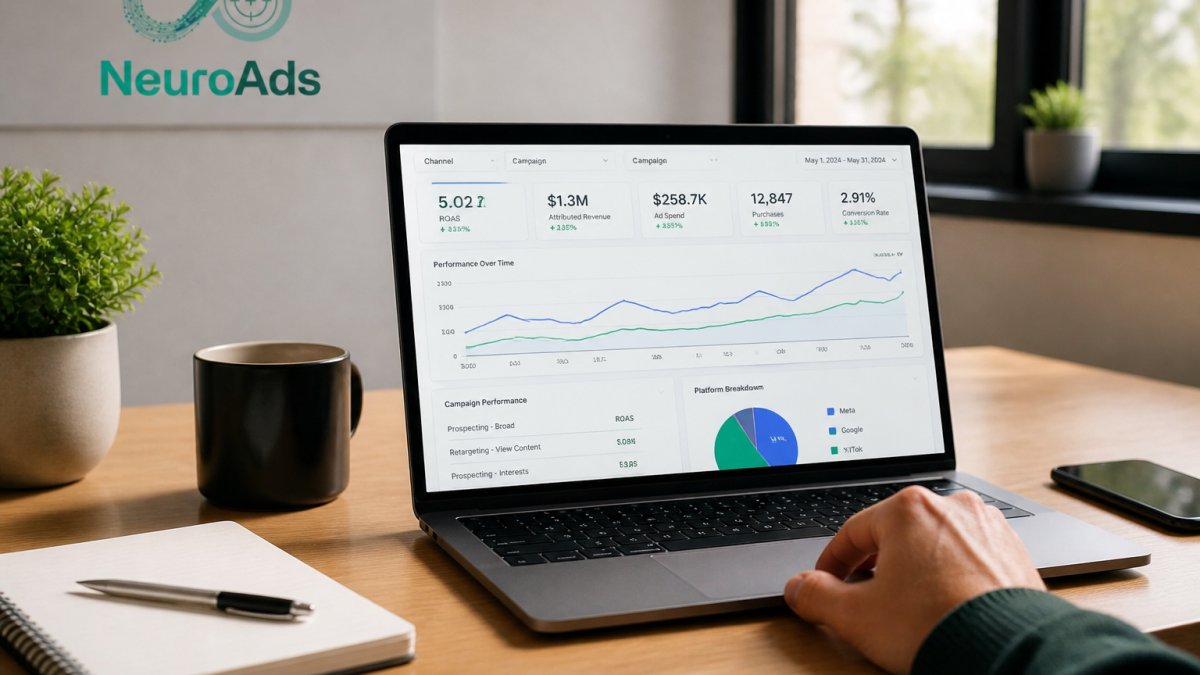
Paid media metrics fall into three categories: spend efficiency, conversion quality, and customer lifetime value. NeuroAds paid media AI tracks all three.
Spend Efficiency: The Table Stakes
Cost per click, cost per lead, and cost per acquisition are the baseline, they tell you how efficiently you are buying attention and actions. But they are blind to whether you are acquiring profitable customers or just cheap ones. A low CPA can be a trap if it attracts discount-seekers who never return.
Conversion Quality: Beyond the First Purchase
Conversion quality metrics reveal whether traffic sources produce customers who stay: repeat purchase rate, average order value by source, and lifetime value by channel. Two campaigns can share an identical CPA but differ wildly in profitability, one acquires customers at $40 with 30% repeating within 90 days, another at $40 with only 5%. NeuroAds paid media AI surfaces these distinctions by connecting paid media data to Shopify performance, showing which campaigns drive profitable conversions.
The Subconscious Response Layer: Measuring What Traditional Metrics Miss
This raises a fair question: is the AI creating genuine preference or manipulating impulse? The platform optimizes for sustainable engagement, signals tied to repeat purchase and loyalty, not just clicks, favoring creative that drives high-intent traffic and long-term value, and surfacing both CPA and 90-day repeat rate so you can see the trade-off.
Long-Term Brand Equity vs. Short-Term Conversion
Most AI ad platforms optimize for the next conversion. NeuroAds paid media AI also tracks brand equity signals: direct traffic growth, branded search volume, and retention curves by acquisition cohort. Brands optimizing purely for short-term ROAS often see diminishing returns after 6-12 months as audience fatigue erodes brand affinity; those balancing conversion with brand-reinforcing creative sustain performance longer. The platform lets you weight campaigns toward brand-building or direct response and reports on both.
Ethical Data Use and Privacy
Neuro-AI optimization relies on behavioral data, which carries responsibility. The platform works with aggregated, anonymized signals, not personally identifiable subconscious profiling, and does not infer sensitive attributes like health, financial status, or political leanings. Data is processed in compliance with applicable privacy regulations, with transparency logs showing which signals influenced which optimizations.
AI Performance Marketing Platform →
Who Should Use NeuroAds Paid Media AI
NeuroAds paid media AI is built specifically for high-growth e-commerce brands operating on Shopify. The platform makes the most sense for businesses in these situations:
- Your current ROAS has plateaued and you've exhausted obvious optimization opportunities (audience expansion, bid adjustments, creative refresh)
- You're spending $10K to $100K monthly on paid media across multiple channels and struggling to coordinate optimization across them
- You have enough traffic volume that small percentage improvements in conversion rate or ROAS generate meaningful revenue impact
- You're willing to integrate your ad accounts and Shopify store to create a closed-loop feedback system
- You want to automate the tactical work of campaign management so your team can focus on strategy and creative
The platform is less suitable for businesses with very small ad budgets (under $5K monthly), brands not on Shopify, or companies that need manual control over every campaign decision and don't want algorithmic optimization.
Implementation and Integration with Your Ad Stack
Getting NeuroAds paid media AI running means building a clean data pipeline from your ad platforms to your storefront. The depth of your integration determines how quickly the AI can make confident decisions.
Connecting Ad Accounts: OAuth, Permissions, and Data Sync
The platform connects to Google Ads, Meta Ads Manager, TikTok Ads, and Pinterest Ads via OAuth 2.0. Grant both read and write access, read for historical data, write for automated bid and budget adjustments.
One detail that matters: the platform normalizes naming conventions across platforms. If your Google Ads and Meta campaigns use different taxonomies, the AI may struggle to compare performance apples-to-apples. Standardize naming (e.g., [Channel]_[Objective]_[Audience]_[Creative]) before connecting, or use the platform's mapping tool to align equivalent campaigns manually.
Shopify Integration: Webhooks, Pixel, and Conversion API
Connecting Shopify is where the closed-loop feedback system comes to life, via three data channels:
- Shopify webhooks for order creation, fulfillment, and customer updates. This gives the platform real-time purchase data, including order value, products purchased, and customer email (hashed for privacy).
- A JavaScript pixel on your storefront to capture on-site behavior, product views, add-to-cart events, checkout initiation, and abandonment. This is essential for understanding the path from ad click to purchase.
- Server-side Conversion API connections to each ad platform. Instead of relying solely on browser pixels (which are increasingly blocked by privacy settings and ad blockers), the platform sends conversion events server-to-server. This improves match rates and ensures the AI trains on complete data.
A common pitfall: duplicate conversion tracking. If you already run Meta Pixel and Google Ads conversion tags, adding the NeuroAds pixel can double-count events unless you configure deduplication. The platform provides a deduplication ID mechanism, work with your developer so existing tags and the new pixel share the same event IDs.
Enriching with CRM and Email Data
The optional but high-value layer is connecting your email platform (Klaviyo, Mailchimp) and CRM (HubSpot, Salesforce).
Integration here is typically via API key or OAuth. The platform pulls customer records and matches them to Shopify customer IDs using email as the join key. Expect 30-60 minutes of field mapping if your CRM uses custom objects or non-standard naming.
Timeline and Troubleshooting
A realistic timeline: 1-2 hours for OAuth connections and pixel installation, 24-48 hours for historical backfill, then 2-3 weeks of live data before recommendations become reliably confident.
If you see flat performance after two weeks, check three things: (1) Are conversion events firing correctly in the platform's event debugger? (2) Is your campaign naming consistent enough for the AI to map equivalents? (3) Have you granted write access, or is the AI only observing?
Conclusion
The gap between how most brands manage paid media and how they could has widened as AI has matured. Manual bid adjustments, static segments, and reactive creative testing are no longer competitive.
NeuroAds paid media AI is built for this reality: it automates tactical campaign optimization while you keep control of strategy, connects paid traffic to profitable customers, and integrates with Shopify to recover lost conversions through intelligent chatbot objection handling.
Get started with the AI Advertising Platform and see how predictive analytics and creative optimization can move your ROAS from stuck to scaling.
Frequently Asked Questions
How does NeuroAds paid media AI reduce wasted ad spend?
NeuroAds uses predictive analytics and behavioral data to identify high-intent audiences before you spend budget on them. AI-driven bid management automatically adjusts bids based on real-time performance signals. The platform tests creative variations simultaneously, so you only scale the assets that drive conversions. This means your media budget goes toward shoppers most likely to purchase, not broad audiences unlikely to convert.
What's the difference between NeuroAds and other AI advertising platforms?
NeuroAds combines three core capabilities: AI-powered ad optimization across channels, predictive targeting based on behavioral data, and an integrated Shopify chatbot for conversion recovery. Unlike recommendation-only tools, NeuroAds executes changes directly in your ad accounts. The platform also handles the entire customer journey from click to purchase, automating objection handling and abandoned cart recovery, not just optimizing the ad itself. This conversion-first approach differentiates it from platforms focused solely on media buying.
Can NeuroAds handle multiple ad platforms at once?
Yes. NeuroAds provides cross-channel campaign management across Google, Facebook, TikTok, and other major ad networks. You get a unified view of performance metrics, budget allocation, and creative testing across all platforms in one dashboard. This eliminates the siloed data problem where insights from one channel don't inform decisions on another. The AI optimizes bidding and targeting rules consistently across channels based on your conversion goals.
How does the Shopify AI chatbot recover abandoned carts?
The integrated Shopify chatbot handles customer objections in real time, answering shipping questions, explaining pricing, or addressing product concerns before shoppers leave. When visitors land on your store after clicking an ad, the chatbot engages them automatically, reducing friction in the purchase process. It captures objections and intent signals that feed back into the AI advertising platform, helping it refine targeting and creative for future campaigns. This closes the loop between paid traffic and conversion recovery.
What results should a DTC brand expect from NeuroAds paid media AI?
Results depend on your starting point, but brands typically see improvements in ROAS through better audience targeting and reduced wasted spend. AI-driven bid management and creative optimization identify which assets drive conversions fastest. The chatbot automation recovers shoppers who would otherwise abandon, improving conversion rate across your entire funnel. Exact improvements vary based on your current setup, audience size, and campaign complexity, visit our website for more information.