 Comparison
Flat Fee vs Percentage of Ad Spend for AI Ad Optimization
Last Updated: November 8, 2026
Quick Summary
AI ad optimization pricing falls into three models: fixed monthly fees, percentage of ad spend, and hybrid or usage-based structures. Fixed fees stay flat as budgets grow, spend percentages rise with every budget increase, and hybrid models combine a base subscription with usage charges.
- AI ad management runs from $29 per month for basic automation to over $10,000 monthly at enterprise level.
- At $100,000 monthly spend, an illustrative $500 fixed fee costs a fifth of a 10% spend-based fee.
- Percentage of spend gives vendors no direct reason to fix a leaky funnel.
- Usage-based contracts often bill overages above the base rate, so one busy month can cost more.
- Model your projected 12-month ad spend and annual cost under each model before signing.
Table of Contents
- AI Ad Optimization Pricing Models Compared
- Percentage of Ad Spend Pricing: When It Helps and When It Hurts
- Usage-Based Advertising Software Pricing Explained
- AI Ad Optimization Tools Comparison: Four Platforms and Their Fee Structures
- AI Marketing Agency Pricing vs Software Pricing
- Total Cost of Ownership: Hidden Fees and Break-Even Math
- Choosing the Right AI Ad Optimization Platform for Your Brand
- Frequently Asked Questions
AI Ad Optimization Pricing Models Compared
AI ad optimization pricing models are the fee structures vendors use to charge for automated campaign management, and they fall into three families: fixed monthly fees, percentage of ad spend, and hybrid or usage-based structures. According to Ryze AI's 2026 pricing comparison, AI ad management runs from $29 per month for basic automation to more than $10,000 per month at enterprise level. At NeuroAds Inc., we see the same three models across nearly every deal we're compared against. The model matters more than the sticker price, because it decides whether your costs stay flat or climb with your budget.
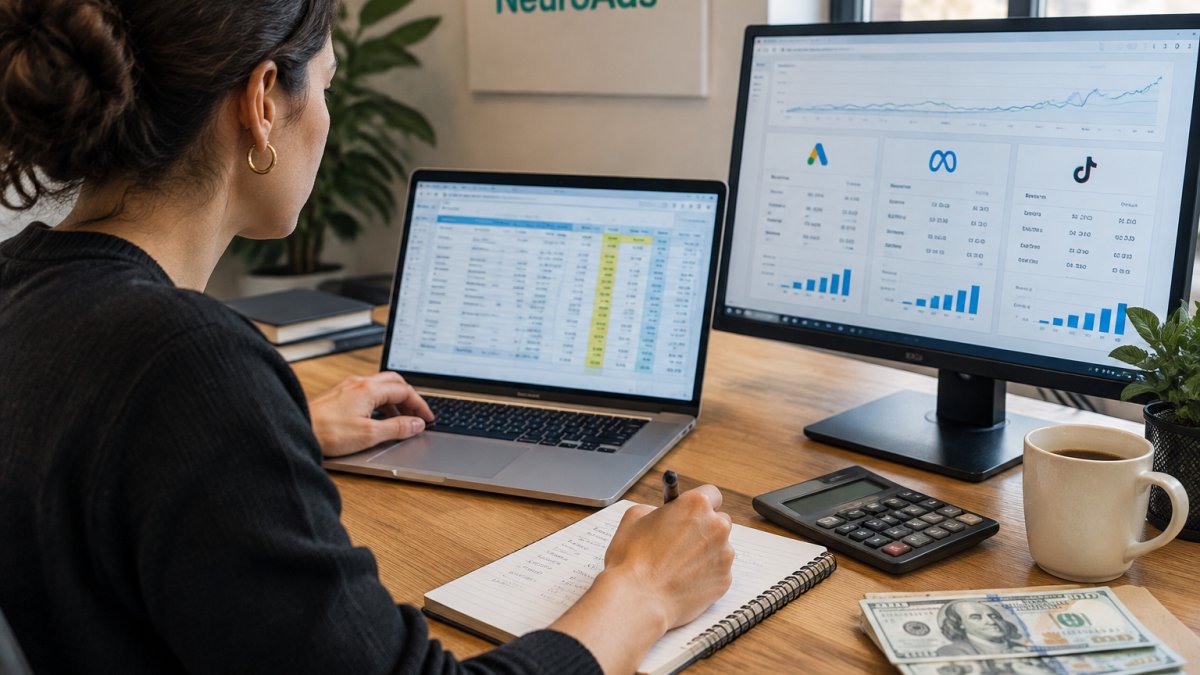
Most pricing guides describe the models in isolation. The useful comparison is side by side, because the same monthly ad budget can produce very different annual costs depending on which structure you sign.
| Dimension | Fixed Monthly Fee | Percentage of Ad Spend | Hybrid / Usage-Based |
|---|---|---|---|
| What drives the fee | Plan tier and feature access | Monthly media budget | Base subscription plus consumption (spend, accounts, campaigns, data) |
| Cost behavior as budget grows | Flat | Rises in lockstep with spend | Rises with usage, often in steps |
| Predictability | High | Medium | Low to medium |
| Minimum commitment | Usually monthly or annual plan | Often a minimum spend threshold | Base plan plus usage floor |
| Overage risk | Low | None (fee scales by design) | High if usage exceeds plan limits |
| Best-fit advertiser | Small, stable budgets | Large, stable budgets | Brands with changing channel or campaign counts |
Fixed Monthly Fee
A fixed monthly fee is a flat subscription that stays the same regardless of how much you spend on ads. The appeal is predictability; the drawback shows up at scale. A flat fee that feels cheap at $5,000 in monthly spend can look expensive at $100,000, because the vendor's workload grows while the price doesn't.
Watch out: flat plans often cap managed campaigns, connected accounts, or seats, so a "flat" fee can quietly become a tier upgrade once you add channels.
Percentage of Ad Spend
Percentage of ad spend pricing ties the vendor's fee to your media budget, usually as a monthly percentage. It aligns incentives in theory: the vendor earns more when you spend more. In practice, your costs rise automatically every time you increase budget, whether or not performance improves. Many contracts also set a minimum monthly fee, so small accounts pay the floor rather than the percentage.
Hybrid and Usage-Based Structures
Hybrid pricing combines a base subscription with a variable component, often a fee tied to spend or usage. Usage-based advertising software pricing charges for what you actually consume: connected accounts, data volume, or managed campaigns. Ryze AI identifies all three models in its 2026 fee-structure breakdown, and hybrid is the fastest-growing because it lets vendors serve small accounts without losing money on them.
Worked Comparison at Three Budget Levels
To see why the model matters more than the headline rate, model each structure at three monthly ad budgets. The figures below use illustrative rates common in the market, not any single vendor's rate card, so substitute your own quotes.
| Monthly ad spend | Fixed fee (illustrative $500/mo) | Percentage of spend (illustrative 10%) | Hybrid (illustrative $200 base + 5% of spend) |
|---|---|---|---|
| $5,000 | $500 | $500 | $450 |
| $25,000 | $500 | $2,500 | $1,450 |
| $100,000 | $500 | $10,000 | $5,200 |
The pattern is the point. At $5,000 in monthly spend, all three models land in a similar range. At $100,000, the fixed fee is a fifth of the percentage-of-spend cost.
Monthly cost of each pricing model at three ad budgets
Percentage of Ad Spend Pricing: When It Helps and When It Hurts
Percentage of ad spend pricing works when your media budget is stable and your vendor's work scales with it.
That's the structural flaw most pricing guides skip. A spend-linked fee gives the vendor a reason to keep budgets high, and no direct reason to fix a leaky funnel.
Percentage pricing fits brands running large, stable budgets where media volume is the main lever.
Usage-Based Advertising Software Pricing Explained
Usage-based advertising software pricing charges for consumption rather than a flat rate or spend percentage. Common units include connected ad accounts, managed campaigns, data rows processed, or seats.
The strength of usage-based pricing is proportionality: a small brand with three campaigns doesn't subsidize an enterprise account. The weakness is forecasting, since usage can spike when you add channels or scale campaigns.
Watch out: usage-based contracts often bill overages at a higher rate than the base tier, so a single busy month can cost more than a fixed plan would have.
AI Ad Optimization Tools Comparison: Four Platforms and Their Fee Structures
The AI ad optimization tools comparison below shows how four real platforms structure their fees. We've kept the comparison like-for-like on model, starting price, and best fit.
| Platform | Pricing Model | Starting Price | Best For |
|---|---|---|---|
| NeuroAds Inc. | Free plan available; paid tiers quoted on request | Free plan available | DTC brands wanting ad optimization plus Shopify chatbot recovery |
| Ryze | Fixed subscription | $99/month | Small to mid-sized businesses wanting predictable ad management |
| Writesonic | Subscription | $39/month | Teams scaling ad creative production |
| Supermetrics | Usage-based and subscription | $9/user/month | Marketers consolidating ad data for analysis |
NeuroAds Inc. is our platform, positioned for DTC brands that want the whole journey covered. Our AI-powered ad optimization and predictive targeting handle bidding and creative testing, while the integrated Shopify chatbot recovers shoppers and handles objections before they leave.
For a broader platform comparison, see our guide to the best AI tool for ads.
AI Marketing Agency Pricing vs Software Pricing
AI marketing agency pricing typically bundles strategy, media management, and creative into a retainer or a spend percentage, while software pricing charges for the tool alone. The agency model buys you people; the software model buys you automation.
Our view: agencies make sense when you have no in-house media buyer and a budget large enough to justify the retainer. Software wins once you have someone who can act on the data.
Total Cost of Ownership: Hidden Fees and Break-Even Math
Total cost of ownership for AI ad optimization includes the subscription, any spend-based fee, overage charges, integration costs, and the internal hours to run the tool. The headline price is rarely the real price. A $99 per month tool that needs 20 internal hours a month to operate costs far more than the invoice suggests.
Most pricing pages quote the subscription and stop there. The full cost stack has six layers, and each one can move your effective cost per dollar of ad spend:
- Base subscription or platform fee, the advertised monthly or annual rate.
- Spend-based or usage fee, the percentage of media or the per-unit charge on accounts, campaigns, or data volume.
- Onboarding and setup, one-time implementation, account connection, or migration fees that many vendors quote separately.
Add those six layers and you have a defensible annual cost estimate. Skip any one and you understate the real number.
A Worked Break-Even Example
Break-even math is simpler than most guides make it. The question is: how much incremental profit must the tool generate to cover its full cost?
- Add your annual subscription, spend-based fees, onboarding, and expected overages to get total tool cost.
- Add internal labor: monthly hours × loaded hourly rate × 12.
- Sum the two for total annual cost of ownership.
- Divide total cost by your contribution margin per conversion to get the number of incremental conversions needed to break even.
- Compare that number to the lift you realistically expect from better bidding, targeting, and creative testing.
For example, if total annual cost of ownership is $18,000 and your contribution margin per conversion is $30, you need 600 incremental conversions a year, or 50 a month, to break even.
Here's the break-even math that matters.
How the Pricing Model Shifts Break-Even
Run the same break-even calculation under each model and the answer changes. A fixed fee keeps total cost flat, so break-even gets easier as your budget grows.
Cost efficiency is now the top reason advertisers cite for adopting AI.
For a deeper look at whether the spend is justified, read our review on whether AI ad management is worth it.
Choosing the Right AI Ad Optimization Platform for Your Brand
Choosing the right platform comes down to matching the pricing model to your spend profile and your team. Use this checklist before you sign:
- Model your monthly ad spend for the next 12 months, not just today
- Calculate the annual cost under each model at your projected spend
- Ask how the fee changes if your ROAS improves without extra spend
The pattern is clear. Fixed fees favor smaller, stable budgets. Spend percentages favor large, stable budgets and vendor-friendly incentives. Usage-based and hybrid models fit brands whose needs change month to month.
Our recommendation: start with a free plan or a short trial, model the real cost at your projected spend, and pick the model that keeps your costs flat as you scale. For a full buyer's framework, read our AI advertising platform buyer's guide, and if you want to see the platform in action, here's what to expect when you book a demo.
The pricing model you choose decides whether your ad management costs stay predictable or climb with every budget increase. NeuroAds Inc. built its platform around a conversion-first strategy, so growth comes from better targeting and recovery, not from a fee that scales with spend.
Frequently Asked Questions
What are the main AI ad optimization pricing models?
Three structures dominate: fixed monthly subscriptions, percentage of ad spend, and hybrid or usage-based plans. Fixed fees stay flat as you scale, percentage models rise with your budget, and hybrid plans combine a base fee with a spend-linked component. Each model shifts risk differently between you and the vendor, so match the structure to how predictable your monthly ad budget is.
Do AI advertising platforms charge a flat fee or a percentage of ad spend?
Both exist, and some vendors offer either. Flat-fee tools keep costs predictable and reward brands that scale spend aggressively, because the fee does not grow with the budget. Percentage-of-ad-spend pricing aligns the vendor's revenue with your media investment but raises your cost every time you increase budgets, which can erode margin during growth pushes. Ask for the fee at your current spend and at double your spend before signing, so you can see how the model behaves as you scale.
Is usage-based advertising software pricing worth it for a small DTC brand?
It can be, if your ad spend fluctuates seasonally. Usage-based plans let you pay less in slow months and more during peak campaigns, which suits brands with uneven budgets. The trade-off is less predictability for planning. Compare the total annual cost of a usage-based plan against a flat subscription at your average monthly spend, and check whether the platform charges for seats, integrations or managed service on top of usage. A free tier, like the one NeuroAds offers, lets you test fit before committing.
How do AI ad optimization tools measure return on investment?
Vendors and buyers typically track return on ad spend, cost per acquisition and conversion rate against a pre-platform baseline. Treat vendor ROI claims as directional and build your own baseline: record ROAS, CPA and conversion rate for 30 days before switching, then compare like-for-like periods. That gives you a defensible number for whether the fee pays for itself.
What should I compare when evaluating AI advertising platform pricing?
Compare the fee at your current and projected spend, the billing mechanics, contract length and cancellation terms, and what is included versus billed separately. Check whether creative testing, audience targeting and cross-channel reporting sit inside the base price or cost extra. Ask how the platform handles budget pacing and bid optimization across channels, since those functions drive the performance the fee is meant to buy. A transparent quote at two spend levels reveals more than a headline starting price.