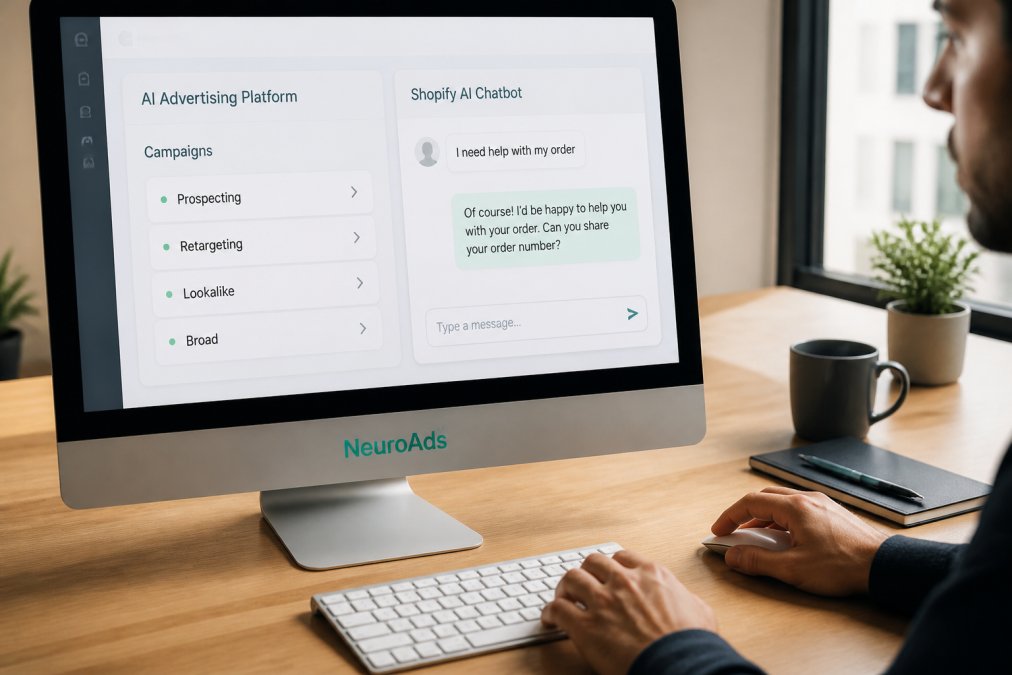
 comparison
Is AI Ad Management Worth It? A 2026 Review
Table of Contents
- The Verdict on AI Ad Management: What the 2026 Data Shows
- Core Benefits of AI Ad Management for E-Commerce Brands
- AI Ad Optimization Strategies That Move the Needle
- Predictive Targeting for E-Commerce: How It Works
- Challenges, Risks, and the Human-in-the-Loop Requirement
- Small Business vs. Enterprise: Who Gets the Most ROI?
- Best AI Marketing Tools 2026: What to Look for in a Platform
- Frequently Asked Questions
Last Updated: August 21, 2026
The Verdict on AI Ad Management: What the 2026 Data Shows
AI ad management uses machine learning algorithms and predictive analytics to automate campaign optimization, bidding, creative testing, and audience targeting across paid media channels. According to eMarketer's 2026 US ad spending forecast cited by Forbes, US AI ad spending will reach $32.03 billion in 2026, nearly tripling last year's total, and will exceed $68 billion by 2030. That's a structural shift in how paid media operates.
At NeuroAds Inc., we've analyzed AI ad management performance across high-growth DTC brands for years. The data is unambiguous: AI tools consistently outperform manual campaign management on efficiency metrics. For most e-commerce brands running paid traffic on Google, Meta, or TikTok, AI ad management is worth it, but "worth it" depends heavily on implementation, use case, and maintaining human oversight to keep algorithmic decisions aligned with brand strategy.
A Meta analysis of over ten thousand ad accounts using Advantage+ Shopping campaigns found that automated setups delivered 32% more conversions with a 17% reduction in cost per acquisition compared to human-managed campaigns. A joint study by Columbia University, Harvard University, the Technical University of Munich, and Carnegie Mellon University found that while AI-generated ads delivered a higher click-through rate (0.76%) than human-made ads (0.65%), human-made ads consistently outperformed AI counterparts in predicting short-term sales impact. AI wins on volume and efficiency; humans still hold the edge on brand resonance and sales conversion quality.

Core Benefits of AI Ad Management for E-Commerce Brands
AI ad management delivers three concrete advantages: faster optimization cycles, better ad spend efficiency, and creative scalability that manual teams cannot match.
Ad Spend Efficiency and Automated Bidding
Automated bidding delivers AI ad management's most measurable impact. According to Zebracat's analysis cited by Adobe, AI-driven PPC bid management can reduce wasted ad spend by around 37% and increase ad ROI by roughly 50%. Campaigns using Dynamic Creative Optimization (DCO) deliver a 32% higher click-through rate and a 56% lower cost per click compared to static creative setups.
AI systems process thousands of auction-level signals simultaneously, adjusting bids based on device type, time of day, audience segment behavior, and historical conversion patterns. For e-commerce brands, automated bidding redistributes spend dynamically toward the highest-performing ad sets within hours of detecting a performance shift, rather than waiting for a weekly review cycle.
Dynamic Creative Optimization and Ad Fatigue Reduction
Ad fatigue is one of the most expensive problems in paid media. According to Omneky platform data (2025), brands using AI creative generation report 30-60% higher click-through rates compared to manually designed ads, and AI-generated ad variations outperform human-designed ads in A/B tests 68% of the time when tested at scale with more than 50 variations.
Dynamic creative optimization assembles ad components, headlines, images, CTAs, and body copy, in real time based on audience signals. Rather than serving the same creative to every user, a DCO system personalizes the ad experience at the impression level, directly addressing ad fatigue.
FULLBEAUTY Brands illustrates this precisely. By swapping plain white catalog backgrounds for AI-generated variations to give Meta's system more creative levers to test, they achieved 45% higher ROAS, a 22% higher conversion rate, and a 36% higher click-through rate compared to their standard setup.
AI Ad Optimization Strategies That Move the Needle
Real-Time Bidding and Budget Allocation
Real-time bidding and intelligent budget allocation are the operational backbone of effective AI ad management. AI systems monitor campaign performance metrics continuously and shift budget toward the ad sets, channels, and audience segments delivering the best return on ad spend.
The quality of data feeding the system is critical. Platforms like Google Performance Max, projected to drive $57 billion in US ad spend in 2026, rely on first-party data signals to optimize effectively. According to StackAdapt's State of Programmatic Advertising 2026 report, advertisers see up to 2X higher ROAS when using first-party data or AI-based contextual targeting compared to third-party targeting. Before layering AI onto your budget allocation, invest in your data infrastructure.
Attribution Modeling and Performance Metrics
Attribution modeling is where AI ad management creates a genuine analytical advantage. Traditional last-click attribution systematically undervalues upper-funnel touchpoints and misrepresents the actual customer journey. AI-powered attribution models analyze cross-channel interactions, weighting each touchpoint based on its actual contribution to conversion.
For e-commerce brands running campaigns across Google, Meta, and TikTok simultaneously, accurate attribution is essential. Without it, budget allocation decisions are based on flawed data. AI attribution systems surface the real performance metrics: customer lifetime value contribution by channel, true cost per acquisition by audience segment, and incremental lift from each campaign type.
| Attribution Signal | What to Measure | Why It Matters |
|---|---|---|
| First-party pixel data | Conversion accuracy by channel | Determines AI optimization quality |
| View-through conversions | Upper-funnel channel credit | Prevents underspending on awareness |
| Cross-device tracking | Customer journey completeness | Reduces duplicate attribution |
| Incrementality testing | True lift vs. organic conversions | Validates AI spend decisions |
| Customer lifetime value | Long-term revenue per acquisition | Prevents optimizing for cheap, low-value customers |
Predictive Targeting for E-Commerce: How It Works
Predictive targeting applies machine learning to identify and reach audiences most likely to convert before they've expressed explicit purchase intent. AI systems analyze behavioral signals, purchase history, browsing patterns, and demographic data to build probabilistic models of future buyer behavior.
According to research from MIT Initiative on the Digital Economy's 2026 study via MIT Sloan, AI-generated personalized video ads outperformed both image ads and generic video in click-through rates across a sample of 21,000 consumers. For DTC brands, predictive targeting addresses the core challenge of audience saturation. As retargeting pools shrink due to cookie deprecation and privacy regulations, prospecting with AI-powered lookalike and behavioral models becomes the primary driver of new customer acquisition.
"It no longer requires a multi-million dollar budget to get AI going in your company. It represents an opportunity to level the playing field for smaller companies." -- Nichole Jordan, Managing Partner at Grant Thornton LLP (Inc. Magazine, 2025)
Predictive targeting tools are genuinely accessible to brands at the $2M-$10M ARR range, not just enterprise tier.
Challenges, Risks, and the Human-in-the-Loop Requirement
AI ad management is not a set-it-and-forget-it solution. The brands that struggle are almost always the ones that removed human oversight too early or handed over strategic decisions the AI wasn't equipped to make.
Algorithmic Bias and Brand Voice Risks
Algorithmic bias in AI ad management manifests in two ways: optimization bias, where the algorithm over-indexes on short-term conversion signals at the expense of brand equity, and creative bias, where AI-generated content regresses toward generic, high-performing templates that erode brand distinctiveness.
A 2026 Bentley University-Gallup Business in Society survey found that 79% of Americans have seen AI-generated advertisements in the past 30 days, and nearly half (49%) view businesses' use of AI to create advertisements negatively. Only 19% view it positively. That perception gap is a real brand risk for DTC companies where brand authenticity is a core purchase driver.
The fix is to maintain a human-in-the-loop process for creative direction and brand voice standards, while letting AI handle variation generation and performance testing within those guardrails.
Integration Complexity and Technical Overhead
Integration complexity is the most underestimated barrier to AI ad management ROI. Most e-commerce brands operate with fragmented data across their Shopify store, email platform, ad accounts, and analytics stack. AI optimization systems require clean, unified data to function effectively.
The practical integration challenges include ensuring consistent pixel and conversion tracking across all ad platforms, connecting Shopify purchase data with email engagement and on-site behavior into a single customer profile, reconciling conflicting attribution windows across Google, Meta, and TikTok, and maintaining stable data pipelines between ad platforms and your analytics or CRM systems. Brands with a clean Shopify-native setup typically see faster deployment than those with legacy systems or multiple third-party middleware layers.
Small Business vs. Enterprise: Who Gets the Most ROI?
The ROI picture for AI ad management differs substantially by business size. For small DTC brands in the $1M-$5M ARR range, AI ad management delivers the highest proportional efficiency gains but requires careful tool selection. A small team cannot absorb a complex platform with a steep learning curve, and the data volume needed for some AI optimization features may not be present at lower ad spend levels.
For small brands, the highest-ROI applications are automated bidding, basic DCO, and AI-powered audience segmentation. These features work with lower data volumes and deliver measurable efficiency gains without requiring a dedicated data engineering team.
For enterprise brands spending six figures monthly on paid media, the ROI calculus shifts toward advanced attribution modeling, cross-channel budget optimization, and AI creative generation at scale. Hatch illustrates this: by building AI into every step of creative production across three personas, three videos, and sixty ad variants, they cut production hours by 50% and costs by 97%, with a 31% improvement in cost per purchase and an 80% jump in CTR.
| Business Stage | Monthly Ad Spend | Primary AI Use Case | Expected ROI Driver |
|---|---|---|---|
| Early DTC | Under $10K | Automated bidding | Reduced wasted spend |
| Growth stage | $10K-$50K | DCO + audience segmentation | Higher CTR, lower CPC |
| Scaling brand | $50K-$200K | Cross-channel optimization | Attribution accuracy, ROAS lift |
| Enterprise | Over $200K | Full AI creative + predictive targeting | Production cost reduction, scale |
Best AI Marketing Tools 2026: What to Look for in a Platform
Selecting from available AI marketing tools in 2026 requires evaluating against criteria that most platform comparison guides underweight. Headline features, AI creative generation, automated bidding, and audience targeting, are now table stakes. The real differentiators are integration depth, attribution accuracy, and whether the platform connects the full customer journey from ad click to purchase conversion.
According to the IAB's 2026 study on AI adoption in creative processes cited by Luma, 83% of ad executives have deployed AI in the creative process, up from 60% in 2024. The current question is which platform architecture best fits your specific e-commerce stack and conversion goals.
What to evaluate when selecting an AI ad management platform:
- Cross-channel campaign management: Does the platform provide a unified view across Google, Meta, TikTok, and Pinterest?
- First-party data integration: How cleanly does it connect with your Shopify store, email platform, and CRM?
- Attribution model flexibility: Can you configure multi-touch attribution, or are you locked into last-click?
- Creative testing infrastructure: Does it support true DCO, or just basic A/B testing?
- Conversion optimization beyond the click: Does the platform address what happens after the ad click, including on-site behavior and cart abandonment?
Most AI ad platforms fall short on that last point. Optimizing for clicks without addressing the conversion gap between landing page and purchase is a structural flaw in most campaign management tools.
NeuroAds Inc. addresses this directly. The platform's conversion-first architecture connects AI-powered ad optimization with an integrated Shopify chatbot that handles real-time objection handling and shopper recovery before visitors abandon. This means the AI optimization loop includes post-click behavior signals, not just ad-level performance metrics, giving the predictive targeting model more accurate data to work with. Brands running NeuroAds can manage cross-channel campaigns across Google, TikTok, Facebook, and Pinterest from a single interface while the Shopify chatbot layer captures the conversion lift that ad optimization alone cannot deliver.
Most DTC brands running paid traffic are losing revenue in two places simultaneously: inefficient ad spend due to poor bidding and targeting, and conversion leakage after the click due to unhandled objections and abandoned carts. The NeuroAds Inc. AI Advertising Platform addresses the ad optimization side with cross-channel campaign management, predictive targeting, and automated bidding. For brands on Shopify, the integrated Shopify AI Chatbot closes the conversion gap by recovering shoppers before they leave. Start with the NeuroAds AI Advertising Platform and connect the full journey from paid click to confirmed purchase.
Frequently Asked Questions
Do AI-driven ad campaigns actually improve ROAS?
Yes, with measurable consistency. Meta's analysis of over 10,000 ad accounts found automated Advantage+ Shopping campaigns delivered 32% more conversions and a 17% lower cost per acquisition versus manually managed campaigns. Separately, AI-driven PPC bid management reduces wasted ad spend by roughly 37% and increases ad ROI by approximately 50%. Results vary by brand size, creative quality, and how well first-party data is integrated, but the directional evidence across multiple large-scale studies is clear.
Is AI ad management suitable for small e-commerce businesses?
Smaller brands often see outsized gains because AI levels the playing field on targeting and bidding precision that previously required large in-house teams. As Grant Thornton's Nichole Jordan noted, it no longer takes a multi-million dollar budget to get AI working for your business. Platforms built for DTC brands, including those with predictive targeting for e-commerce, can start delivering performance signals even at modest monthly ad spend, though integration complexity and learning curves still require some setup investment.
What are the risks of relying solely on AI for ad management?
Over-automation is the primary risk. AI optimizes aggressively for short-term performance metrics, which can erode long-term brand equity and introduce algorithmic bias in audience segmentation. A 2026 Ipsos study found that while consumers largely cannot distinguish AI-generated ads from human-made ones, human-made ads still outperformed AI counterparts in predicting short-term sales impact. Strategic oversight, brand voice review, and regular benchmark analysis remain essential. AI ad management works best as a human-in-the-loop system, not a fully autonomous one.
How does AI-powered ad optimization differ from manual bidding?
Manual bidding relies on fixed rules and periodic human adjustments. AI ad optimization uses machine learning algorithms to process real-time signals, including device, time of day, audience behavior, and conversion probability, adjusting bids at the impression level. Campaigns using dynamic creative optimization deliver a 32% higher click-through rate and 56% lower cost per click compared to static setups. The practical difference is speed and scale: AI processes millions of data points per second, far beyond what any manual workflow can match.
How much does AI ad management cost?
Pricing structures vary widely across platforms. Some charge a percentage of ad spend, others use flat monthly fees or tiered plans based on features. Because costs scale differently depending on your budget, channel mix, and required integrations, there is no universal benchmark. Visit the AI Advertising Platform at app.neuroadsinc.com to understand current pricing options and how they align with your specific campaign scale and goals.
This article was written using GrandRanker