 comparison
CausalFunnel Alternatives for Scaling Brands
Table of Contents
- Why Scaling Brands Outgrow CausalFunnel
- CausalFunnel Alternatives for E-Commerce: Feature Comparison
- NeuroAds Inc.: AI-Powered Growth for High-Growth DTC
- DTC Growth Platform Essentials: What to Evaluate
- Shopify Abandoned Cart Recovery and Conversion Automation
- Paid Traffic Optimization for DTC Brands: The Missing Piece
- Decision Framework: Choosing Your Next Growth Platform
- Frequently Asked Questions
Last Updated: October 9, 2026
Why Scaling Brands Outgrow CausalFunnel
Scaling brands hit a wall with generic marketing platforms that optimize for volume, not profitability. Past initial traction, you need systems that connect paid traffic directly to conversions, not impressions and clicks.
The issue isn't CausalFunnel itself. Scaling brands need AI-powered targeting that learns from conversion data, Shopify integration that handles objections before customers leave, and cross-channel campaign management that treats every touchpoint as one journey.
This guide covers causalfunnel alternatives scaling for brands and how to choose the one that fits your growth stage.
CausalFunnel Alternatives for E-Commerce: Feature Comparison
Most comparison tables for this category mix CausalFunnel lookalikes with unrelated funnel builders and data platforms. Before evaluating any alternative, you need a baseline: what does CausalFunnel do well, and where does it stop being enough?
CausalFunnel's core strength is session-level behavioral analytics: it records sessions, identifies funnel drop-off points, and surfaces where shoppers hesitate. For a brand doing a few hundred thousand in monthly revenue, that visibility is useful.
The real question is not "which tool looks like CausalFunnel" but "which tool closes the loop from diagnosis to action."
Here is how the leading alternatives stack up against that frame, including what each one is actually built for:
| Platform | Category | Best For | Key Strength | Growth-Stage Fit | Integration Focus |
|---|---|---|---|---|---|
| CausalFunnel (baseline) | Behavioral analytics | Early-stage DTC diagnosing funnel drop-off | Session recording, funnel visualization | Pre-scale (under ~$500K/mo revenue) | Shopify, GA, ad pixels |
| NeuroAds Inc. | AI ad optimization + Shopify chatbot | DTC brands scaling paid traffic profitably | Conversion-data-driven bidding + on-site objection recovery | Scaling DTC (multi-channel, high ad spend) | Shopify, Google, Meta, TikTok, Pinterest, email |
| Agentforce Marketing | Enterprise marketing automation | Large orgs already on Salesforce | CRM-native workflow orchestration | Enterprise | Salesforce ecosystem, CRM-first |
| Act-On | Mid-market lead gen | B2B lead capture and nurturing | Email + landing page builder | Mid-market B2B | Lead capture, CRM, basic ad sync |
| Moosend | E-commerce email marketing | Email-first retention programs | Segmentation and automation flows | Early to mid-stage ecommerce | Email-first, limited ad integration |
| Triple Whale | Attribution and analytics | DTC brands consolidating reporting | Multi-touch attribution dashboard | Scaling DTC (analytics layer only) | Shopify, ad platforms, analytics |
Two things stand out through a scaling lens.
First, most of these tools solve one slice of the problem. Triple Whale is excellent at attribution but does not run your ads or recover carts. Moosend handles email retention but not acquisition. Act-On is built for B2B lead gen, not DTC conversion.
Second, tools that combine acquisition optimization with on-site conversion recovery are rare.
A practical pressure test: ask what happens the moment a shopper hesitates at checkout. Does the platform see it, act on it, and feed that action back into how the next dollar of ad spend is allocated? If the answer is no at any step, you are looking at a partial solution, exactly what scaling brands outgrow.
Shopify app ecosystem overview
NeuroAds Inc.: AI-Powered Growth for High-Growth DTC
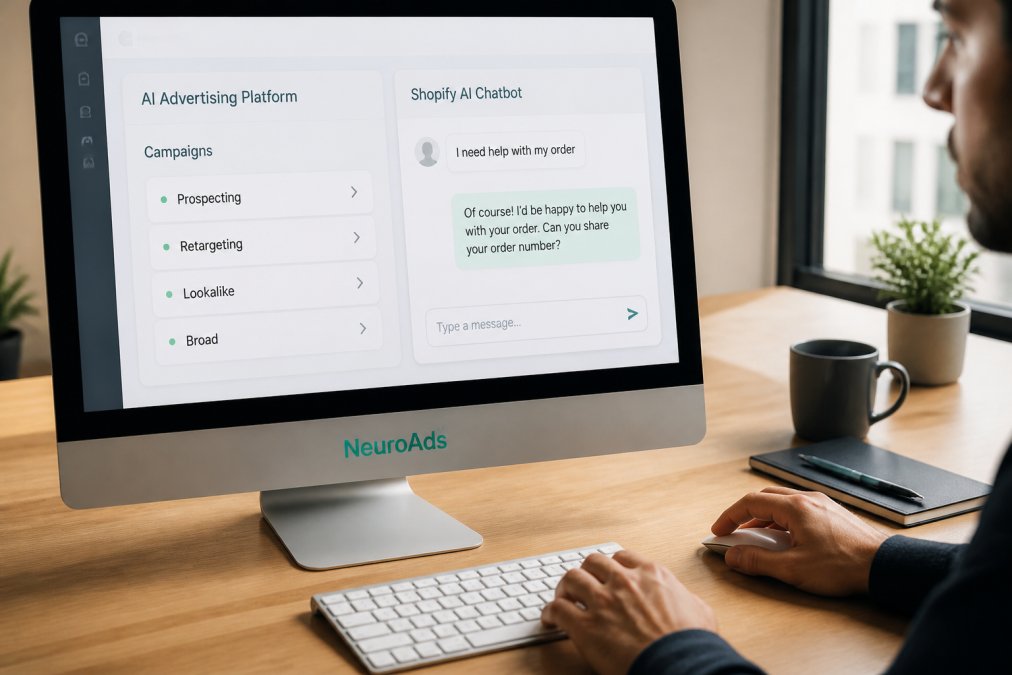
NeuroAds Inc. is built for DTC brands past the startup phase that need to scale profitably, combining AI-powered ad optimization, predictive targeting, and integrated Shopify chatbot automation.

What makes NeuroAds Inc. different is its conversion-first approach: instead of optimizing for clicks or impressions, it learns from your actual conversion data to identify which audiences, creative variations, and bidding strategies drive profitable customers, not just traffic.
The integrated Shopify chatbot handles a problem most platforms ignore: shoppers ready to buy but held back by last-minute objections. A customer lands on your product page, sees the price, and hesitates. Instead of abandoning, they hit the chat.
Scaling brands also need unified visibility.
The platform includes cross-channel campaign management: test creative, audiences, and messaging across multiple ad networks from a single interface, with automated comparison and optimization instead of manual per-platform reporting.
DTC Growth Platform Essentials: What to Evaluate
Choosing among causalfunnel alternatives scaling means understanding what actually matters for growth, not generic feature checklists.
Start with conversion tracking accuracy. A platform can only optimize what it measures; if conversion data is delayed, incomplete, or siloed, optimization becomes guesswork.
Next, evaluate integration with your existing stack. Most scaling brands run Shopify, Google Analytics, email platforms, and multiple ad networks.
Consider automation depth. Can the platform automate audience segmentation, bid adjustments, and creative rotation, or does it require manual intervention? Scaling brands don't have time for manual optimization; automated workflows free your team to focus on strategy.
Attribution and reporting matter more at scale. When spending across multiple channels, you need to know which drive profitable customers. Single-touch attribution (crediting the last click) misleads you; multi-touch attribution shows the true customer journey and helps you allocate budget more effectively.
Finally, assess the learning curve and support. A powerful platform that takes months to implement costs you in opportunity; the best alternatives balance capability with usability and are operational within days, not weeks.
AI Performance Marketing Platform →
Shopify Abandoned Cart Recovery and Conversion Automation
One of the highest-value opportunities for scaling DTC brands is recovering abandoned carts before they're truly lost. Most platforms treat this as an email problem, a reminder 24 hours after abandonment. That works, but it's reactive.
The better approach is intervention before abandonment. A customer adds items to cart, starts checkout, then hesitates, that's the moment to act. An AI chatbot can ask what's holding them back: shipping cost, product fit, payment options.
This is where Shopify integration becomes critical. Your chatbot needs to see cart contents, understand product details, and know your policies in real time. Generic chatbots can't, they require extensive manual training and often deliver responses that frustrate customers.
NeuroAds Inc.'s Shopify chatbot is trained on your product data and policies. It handles real objections, not scripted responses, and recovers shoppers at the moment of hesitation.
The platform also automates post-purchase sequences, tracking updates, product recommendations, loyalty offers, keeping customers engaged and increasing lifetime value without manual email campaigns.
Paid Traffic Optimization for DTC Brands: The Missing Piece
Most scaling brands focus on audience and creative testing. Those matter. But the real bottleneck for DTC profitability is often bid strategy and budget allocation.
Generic platforms optimize for cost per result (CPA), acquiring customers as cheaply as possible. That sounds good until you realize it often means acquiring the wrong customers: a low-CPA customer might have zero lifetime value, while a higher-CPA customer might become a repeat buyer worth 5x the initial purchase.
The best CausalFunnel alternatives optimize for actual profit, not just acquisition cost. They track lifetime value, repeat purchase rates, and margin per customer, then adjust bids to acquire customers who will be profitable long-term, not just cheap short-term.
This requires real-time integration between your ad platform and Shopify. NeuroAds Inc. connects these systems so bid adjustments follow actual customer behavior, not assumptions: strong repeat-purchase segments see bids increase, high-churn segments see bids decrease.
For scaling brands, this compounds monthly: better targeting lowers acquisition costs, higher margin frees more budget for scaling, and that reinvestment accelerates growth.
Decision Framework: Choosing Your Next Growth Platform
Most "how to choose" sections give you a feature checklist, not a decision framework. A real framework starts with two questions: what business model are you running, and what growth stage are you in?
Use this selection matrix, organized by business model and growth stage, to narrow the field before you open a demo.
| Business Model | Early Stage (finding product-market fit) | Scaling Stage (proven offer, growing spend) | Mature Stage (multi-channel, multi-SKU) |
|---|---|---|---|
| DTC ecommerce | Prioritize cheap, fast setup. Analytics-first tools like CausalFunnel or Triple Whale give you funnel visibility without heavy onboarding. | Prioritize conversion-data-driven ad optimization plus on-site recovery. This is where an AI advertising platform paired with a Shopify AI chatbot compounds. | Prioritize cross-channel budget allocation and lifetime-value modeling. You need one source of truth across paid, email, and organic. |
| SaaS | Prioritize CRM-native automation (Agentforce, Act-On) to manage long sales cycles. | Prioritize attribution across trials, demos, and paid signups. Multi-touch reporting becomes non-negotiable. | Prioritize retention and expansion analytics. Acquisition cost matters less than net revenue retention. |
| Agency / multi-client | Prioritize white-label reporting and per-client dashboards. | Prioritize automation depth so one team can run many accounts without headcount scaling linearly. | Prioritize API access and custom reporting for enterprise clients. |
| Multi-channel retail | Prioritize unified inventory and channel-level attribution. | Prioritize paid traffic optimization across Google, Meta, TikTok, and Pinterest from one interface. | Prioritize margin-per-customer optimization and repeat-purchase bidding. |
Now layer in the growth-stage logic most comparison articles skip.
Early stage. Your bottleneck is learning, not scale. You need fast setup, low commitment, and clear funnel visibility, so analytics-first tools are the right call.
Scaling stage. Your bottleneck flips. With a proven offer and rising ad spend, the constraint is profitability per dollar spent, and diagnostic tools stop being enough.
Mature stage. Your bottleneck is coordination. With multiple channels, SKUs, and teams, the priority shifts to unified reporting, lifetime-value modeling, and margin-aware bidding. Integration depth matters more than any single feature.
A few trade-offs worth naming, because no platform wins on every axis:
- Breadth vs. depth. Platforms that try to do everything often do nothing exceptionally. The strongest scaling stacks tend to be one deep platform for acquisition and conversion, plus one or two specialized tools for retention or analytics.
- Automation vs. control. More automation means less manual work but less ability to override the algorithm when you have context it lacks. Look for guardrails rather than forced autopilot.
- Setup speed vs. ceiling. Tools that onboard in a day usually cap out sooner; tools that take weeks to configure often scale further. Match the trade-off to your stage.
Frequently Asked Questions
What are the best CausalFunnel alternatives for scaling brands?
The best CausalFunnel alternatives depend on your growth stage and priorities. Scaling brands typically need platforms that combine AI-powered ad optimization, cross-channel campaign management, and conversion-focused automation. Look for tools that integrate seamlessly with Shopify, provide real-time analytics, and offer predictive targeting to improve ROAS. NeuroAds Inc. stands out for DTC brands specifically, combining AI ad optimization with integrated chatbot automation for shopper recovery and objection handling across your entire customer journey.
How can a DTC growth platform improve ROAS for paid traffic?
A strong DTC growth platform improves ROAS by fixing two critical gaps: targeting precision and conversion efficiency. AI-powered platforms analyze campaign performance data to identify which audiences, creatives, and bidding strategies drive profitable customers. They also automate the post-click experience through tools like chatbot-based objection handling and abandoned cart recovery, ensuring you convert traffic you've already paid to acquire. This combination of front-end optimization and back-end conversion automation directly increases return on ad spend.
What features should I prioritize in a Shopify abandoned cart recovery solution?
Effective Shopify abandoned cart recovery requires three core features: automated detection and messaging triggered by cart abandonment, intelligent objection handling that addresses real shopper concerns, and seamless integration with your Shopify store and email platform. The best solutions use conversational AI to engage shoppers in real-time rather than relying solely on email sequences. Integration with your CRM and analytics platform ensures you can measure recovery rate and attribute revenue back to the recovery effort.
How long does it typically take to see ROAS improvements after switching platforms?
ROAS improvements depend on how quickly you can migrate campaigns and data, and how well the new platform understands your historical performance. Most scaling brands see initial insights within 2-4 weeks once data is flowing, but meaningful ROAS gains typically emerge within 60-90 days as the platform's AI models train on your campaign data. Faster results come from platforms that can ingest your historical performance data and apply learnings immediately rather than starting from scratch.
The difference between stalled growth and accelerating growth often comes down to platform choice. A generic tool keeps you stuck optimizing for clicks. The right platform, one built for scaling DTC brands, lets you optimize for profit. Explore how NeuroAds Inc.'s AI Advertising Platform handles the full customer journey, from paid traffic to Shopify checkout, and discover why scaling brands make the switch.