 comparison
AdCreative AI Alternative for Ecommerce: 5 Tools (2026)
Table of Contents
- Why Ecommerce Brands Outgrow AdCreative AI
- Quick Comparison: 5 AdCreative AI Alternatives for Ecommerce
- NeuroAds Inc.: Conversion-First AI Advertising Platform for Shopify
- AI Ad Creative Tools for Ecommerce: Rocketium and Abyssale
- AI Video Ad Generators for Ecommerce: Creatify and Zeely
- Ecommerce Ad Creative Testing: How the Five Tools Compare
- Total Cost and Integration Depth: What AdCreative AI Roundups Miss
- Conclusion: Choosing Your AdCreative AI Alternative
- Frequently Asked Questions
Last Updated: October 7, 2026
Why Ecommerce Brands Outgrow AdCreative AI
Most ecommerce brands do not leave their first ad creative tool because it stops working. They leave because it stops keeping up.
AdCreative AI built its reputation on fast, template-driven image ads, and for a brand running one product line on a single channel, that is often enough. The problem shows up later. Creative volume rises, channels multiply, and the tool that once saved time starts creating a different kind of work: exporting assets, rebuilding variations by hand, and guessing which version actually drove the sale.
An adcreative ai alternative for ecommerce is a platform that generates ad creative and connects it to the data that proves whether it performed. That distinction matters more than feature lists suggest. According to Shopify's guidance on product feed requirements, ad platforms pull directly from structured catalog data, which means a creative tool that cannot read your feed is working with a partial picture of your store.
At NeuroAds Inc., we work with DTC brands that hit this wall somewhere between consistent spend and real scale. Below, we break down five alternatives, what each one does well, and where each one falls short.
Quick Comparison: 5 AdCreative AI Alternatives for Ecommerce
The five tools below split into two groups: creative production platforms and full advertising platforms. Pick based on whether your bottleneck is making assets or converting the traffic those assets bring in.

| Tool | Primary Strength | Best For | Free Tier |
|---|---|---|---|
| NeuroAds Inc. | Conversion-first ad optimization plus Shopify chatbot | DTC brands focused on ROAS | Yes |
| Rocketium AI Studio | AI production with human review | Brands needing retailer compliance | No |
| Abyssale | Creative automation for ad assets | Ecommerce and SaaS teams | No |
| Creatify | UGC-style video ads | Brands without filming resources | Yes |
| Zeely AI | Static and short video creative | Meta-ready campaigns | No |
NeuroAds Inc.: Conversion-First AI Advertising Platform for Shopify
NeuroAds Inc. is our top pick because it treats creative as one input into conversion, not the whole job. Most alternatives stop at asset generation. This one runs the full path from ad click to purchase.
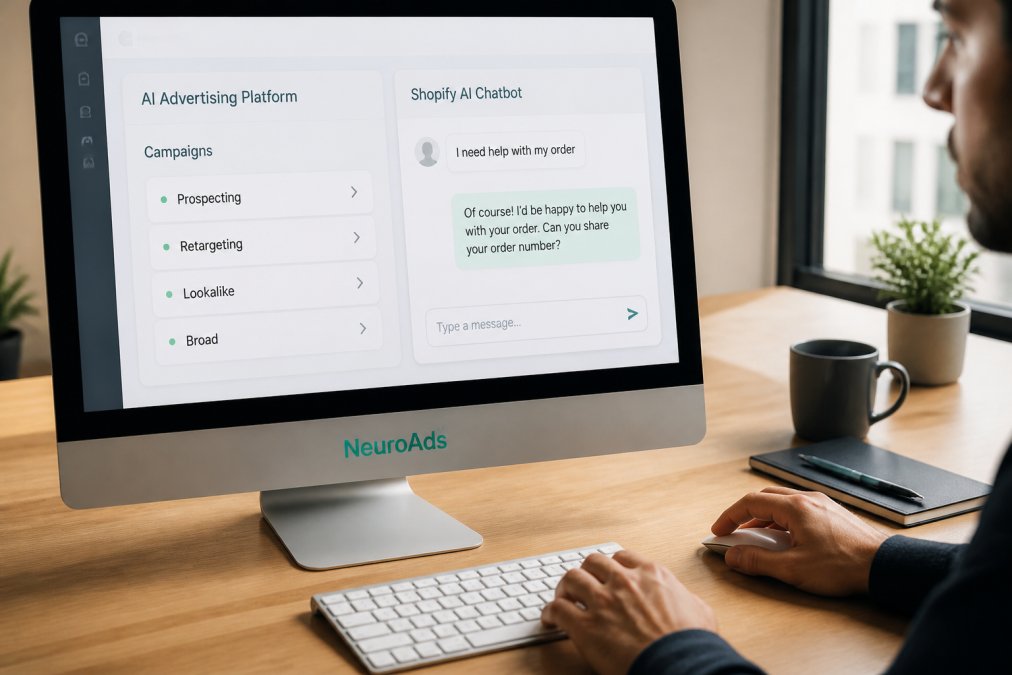
The platform combines AI-powered ad optimization and predictive targeting with a Shopify chatbot that handles objections and recovers shoppers before they leave. Creative testing, bidding, and targeting adjustments feed off the same performance signals, so a winning ad gets more budget without a manual export.
Where it stands apart is the handoff. A shopper clicks an ad, lands on the store, hesitates on a product page, and the chatbot answers the objection in the moment. That is the gap most creative tools leave open.
Pros:
- Cross-channel campaign management in one view
- Automated shopper recovery built into the funnel
- Optimized targeting, bidding, and creative testing together
Cons:
- Built for ecommerce and DTC, so it is not a fit for general brand marketing
- Pricing depends on your setup, so you need a quote rather than a published tier
AI Ad Creative Tools for Ecommerce: Rocketium and Abyssale
Rocketium AI Studio and Abyssale both solve the production problem, and they solve it differently. The distinction matters because the two tools sit at opposite ends of the same workflow: one is built around review and approval, the other around volume and speed.
Rocketium AI Studio pairs AI generation with human expert review and includes retailer compliance checks. That combination suits consumer brands selling through retail partners, where an ad that violates a retailer's creative rules gets rejected.
Abyssale focuses on automation: building advertising assets at volume and connecting that output to ecommerce workflows.
Neither tool manages your ad spend or adjusts targeting. They make the creative; you still run the campaign.
Where both tools leave a gap for ecommerce teams: catalog synchronization. A creative tool that cannot read your product feed is working from a snapshot, not a live catalog.
Brand consistency and compliance controls: Rocketium's review layer is the stronger of the two here, because it inserts a human checkpoint before assets ship.
AI Video Ad Generators for Ecommerce: Creatify and Zeely
Video is where creative budgets go to die, which is exactly why these two exist.
Creatify generates UGC-style video ads without filming or hiring influencers. For a brand testing video for the first time, that removes the two biggest cost barriers. It offers a free tier, though plan pricing and API access are not published.
Zeely AI covers static ads and short-form video in one place, with product-led creative aimed at Meta campaigns. It is a reasonable single-tool option for advertisers who want both formats without juggling platforms. Pricing, integrations, and API availability are not verified in the supplied comparison, so confirm those before committing.
The honest limitation for both: generating a video ad is not the same as knowing which version converts. That requires testing infrastructure neither tool provides on its own.
AI Performance Marketing Platform →
Ecommerce Ad Creative Testing: How the Five Tools Compare
Ecommerce ad creative testing is the practice of running multiple creative variations against real traffic and shifting budget toward the winners. It is the step that separates tools producing assets from tools producing revenue.
The workflow has four stages, and the tools differ on how many of them they actually handle:
- Brief and variant generation, define the product, the angle, and the format, then produce variations.
- Catalog binding, attach each variant to live product data so price, inventory, and imagery stay accurate.
- Traffic allocation, serve variants against real audiences with enough spend per variant to reach a readable result.
- Decision and reallocation, read the metrics, kill the losers, and move budget to the winners.
Here is where the five land:
- NeuroAds Inc.: Testing is native. Creative variations feed directly into optimization, and results inform the next round of targeting and bidding. Stages 1 through 4 sit inside one system, which is the difference between a test that runs and a test that gets abandoned halfway.
- Rocketium AI Studio: Produces variants efficiently. Testing happens in your ad platform. Stages 1 and 2 are covered; 3 and 4 are not.
- Abyssale: Strong at volume production. No built-in performance loop. Stages 1 and 2 only.
- Creatify: Fast video variants. You test them yourself. Stage 1 only.
- Zeely AI: Multiple formats from one tool. Testing is external. Stage 1 only.
The gap is not subtle. If you generate twenty creative variations and test them manually, you have added work rather than removed it. According to Google's guidance on responsive search ads, letting the platform test combinations against real queries consistently outperforms picking winners by hand.
What a readable test actually requires. A common pattern among ecommerce teams is to run a test until each variant has accumulated enough impressions and conversions to distinguish a real difference from noise.
The metrics that decide it. Click-through rate tells you whether the creative earns attention. Cost per acquisition and return on ad spend tell you whether that attention converts into profitable orders.
Methodology transparency. When a tool claims its creative performs better, the useful question is what was tested, against what baseline, and over what sample. Generation features and demonstrated outcomes are different claims, and most roundups conflate them. Ask for the test setup before you trust the result.
Team workflow and approval. Testing at volume creates a second problem: who approves what ships. Growing ecommerce teams need an approval flow that lets a media buyer queue variants, a brand lead sign off, and the system push approved assets live without a manual handoff. Tools that treat approval as an afterthought push that coordination into spreadsheets and chat threads, which is where testing programs quietly stall.
Total Cost and Integration Depth: What AdCreative AI Roundups Miss
Most roundups list a starting price and move on. That number tells you almost nothing about what the tool costs you in practice.
Three costs get ignored:
- Per-seat or per-asset limits. A low entry price often caps exports or users, so the real cost climbs as you scale.
- Integration work. If the tool cannot read your product catalog and sync with your ad accounts, someone rebuilds that connection manually every campaign.
- The cost of not converting. A tool that saves you creative hours but leaves your conversion rate flat has not saved you money.
Integration depth is the harder problem. A creative tool that syncs with your product feed can pull current prices, inventory, and images automatically. One that cannot will eventually run an ad for an out-of-stock item. The Federal Trade Commission's advertising and marketing guidance is clear that advertised claims must be accurate and substantiated, and stale catalog data creates exactly that risk.
This is where a full platform beats a creative-only tool: fewer handoffs, fewer places for data to go stale.
Conclusion: Choosing Your AdCreative AI Alternative
The right adcreative ai alternative depends on where your funnel actually breaks. If creative production is the bottleneck, Rocketium, Abyssale, Creatify, and Zeely all address it. If the bottleneck is turning traffic into customers, production tools will not close that gap.
That is the problem NeuroAds Inc. was built for. Our AI advertising platform connects predictive targeting, optimized creative testing, and cross-channel campaign management, while the Shopify chatbot handles objections and recovers shoppers mid-session. One system, from click to purchase.
If your ROAS has plateaued and more creative has not fixed it, the issue is probably not the ads. Explore the NeuroAds Inc. AI advertising platform and connect the whole journey instead of just the top of it.
Frequently Asked Questions
What is the best AdCreative AI alternative for ecommerce brands?
It depends on your bottleneck. If creative volume is the problem, Rocketium and Abyssale produce ad assets at scale. If you need UGC-style video without filming, Creatify and Zeely cover that. If the real gap is conversion after the click, NeuroAds Inc. pairs an AI advertising platform for Shopify with chatbot-led objection handling, so creative, targeting, and on-site recovery run as one system instead of separate tools.
Which AdCreative AI alternative is best for creating video ads?
Creatify is built specifically for UGC-style video ads and is aimed at ecommerce brands without in-house filming resources or influencer access. Zeely also covers short-form video alongside static product creative. If your video ads need to feed directly into cross-channel optimization and post-click conversion data, NeuroAds Inc. handles video creative testing within its broader campaign management rather than as a standalone generator.
Can AI ad tools help ecommerce brands test more creative variations?
Yes, and that is the main reason brands switch. Tools like Rocketium, Abyssale, and Zeely generate multiple ad formats and creative variations quickly, which makes ecommerce ad creative testing practical at volume. The catch is that generation alone does not tell you which variation wins. Pair any generator with a platform that reads performance data, such as click-through rate, conversion rate, and return on ad spend, so testing cycles actually inform the next batch of creative.
What should ecommerce brands compare when choosing an AI ad tool?
Compare four things: integration depth, especially how well the tool syncs your product catalog and Shopify data; how creative variations get tested against real performance data; total cost based on your use case rather than the sticker price alone; and brand consistency controls, including how well the tool enforces your brand guidelines across every generated ad. Roundups that only list features miss the integration and cost questions that decide whether a tool pays for itself.
How can AI be used in ecommerce advertising beyond making ad images?
Beyond image generation, AI handles audience targeting, bid optimization, creative testing, and post-click recovery. For example, NeuroAds Inc. uses predictive targeting and performance signals to optimize campaigns across channels, then routes shoppers into a Shopify chatbot that answers objections and recovers abandoned carts. That combination treats the ad click and the purchase as one funnel, which is where most ecommerce brands lose return on ad spend.