 comparison
AI Marketing Platform: What Works for DTC Brands
Table of Contents
- What Is an AI Marketing Platform?
- Core Capabilities: AI Advertising Platform and Campaign Optimization
- AI Marketing Automation Platforms: Workflow and Efficiency
- Essential AI Marketing Tools for DTC Brands
- What Actually Matters When Selecting an AI Marketing Platform
- Platform Fit by Brand Scale and Team Maturity
- Frequently Asked Questions
Last Updated: October 13, 2026
What Is an AI Marketing Platform?
An AI marketing platform is software that uses machine learning and generative AI to automate and optimize the entire customer journey, from ad targeting and creative testing through conversion tracking and post-purchase recovery.
The core idea: AI handles the repetitive, data-heavy work humans struggle with at scale, learning from your data and adjusting in real time instead of relying on manual testing or guesswork.
According to HubSpot's 2026 Marketing Statistics, nearly 75% of marketers are already using AI in some form.
Core Capabilities: AI Advertising Platform and Campaign Optimization
The best AI marketing platforms connect ad spend, creative performance, and customer behavior into a single feedback loop, the difference between tools that feel helpful and tools that move ROAS.
Predictive Targeting and Audience Segmentation
Predictive targeting uses historical customer data to identify prospects most likely to convert before you show them an ad, learning which behavioral signals, device types, purchase histories, and engagement patterns predict a sale.
Audience segmentation goes deeper. Rather than one "interested in sneakers" segment, AI breaks your audience into micro-segments, cart abandoners, product-page viewers who didn't click, email engagers who never visited the site, each getting a different message, bid strategy, and creative.
The difference shows up in cost per acquisition.
Creative Optimization and Performance Measurement
AI doesn't write your ads, you do.
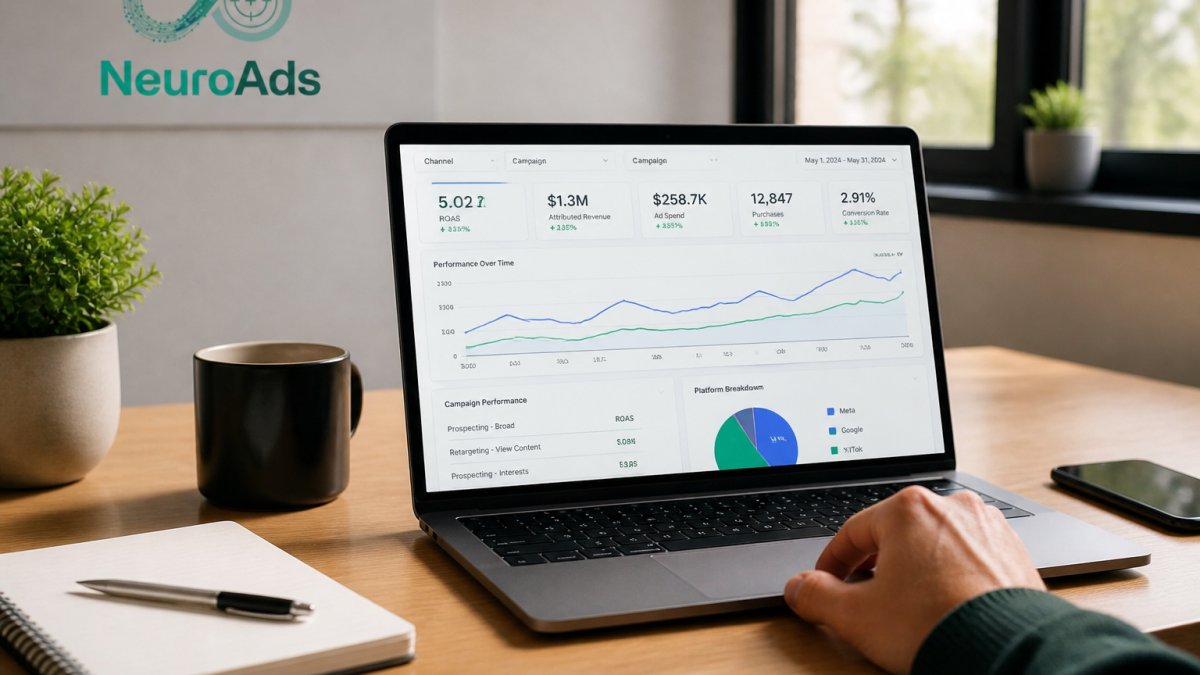
Performance measurement is where most platforms fall short: they show clicks and conversions, not why they happened. The best connect ad performance to actual revenue, showing which creatives, audiences, and placements drove profitable sales.

AI Marketing Automation Platforms: Workflow and Efficiency
Automation handles the workflows that eat time without adding strategy: behavior-triggered email sequences, abandoned cart recovery, post-purchase follow-ups.
The real value isn't just speed. It's consistency. A human-managed workflow might miss a segment or send a message at the wrong time. Automation ensures every prospect gets the right message at the right moment, every single time.
Workflow automation frees your team to focus on strategy, analyzing why a campaign underperformed rather than manually emailing 10,000 abandoned cart customers.
Essential AI Marketing Tools for DTC Brands
For DTC brands specifically, two capabilities matter most: cross-channel campaign management and conversion recovery at the point of objection.
Cross-Channel Campaign Management
DTC brands live across Facebook, TikTok, Google, Pinterest, email, and SMS. A fragmented approach optimizes each channel in isolation, missing how a customer moves between touchpoints.
Cross-channel management means one platform sees all of it. A customer sees your TikTok ad, clicks to your Shopify store, reads the product page, hesitates at checkout, and leaves.
NeuroAds Inc. connects your ad accounts, email platform, and Shopify store into a single data model, so you can see which ad platforms drive the highest-quality traffic, which email sequences convert those visitors, and where you're losing people.
Shopify AI Chatbot for Conversion and Recovery
One of the highest-use tools for DTC brands is a Shopify AI chatbot that handles objection handling and cart recovery before customers leave.
The Shopify AI Chatbot from NeuroAds Inc. is built specifically for e-commerce objections. It captures hesitant shoppers before they abandon cart and answers questions in real time, so your team isn't manually answering the same five questions all day.
What Actually Matters When Selecting an AI Marketing Platform
Most platforms make big promises. The real differentiators are boring: implementation speed, data integration, transparency, and governance.
Implementation Speed and Data Integration
An AI platform is worthless if it takes three months to get running.
Ask for a documented onboarding timeline with specific milestones: Day 1 data connection, Day 3 first recommendations, Day 7 first automated action.
Data integration is the bottleneck. Your Shopify store, email platform, ad accounts, and analytics tool each hold pieces of the customer journey.
Native integrations matter more than API access.
Transparency, Governance, and Human Control
AI should amplify human judgment, not replace it. The best platforms show you why they're recommending a bid change or pausing an audience.
Governance matters too. You should be able to set guardrails: "Don't pause this audience without my approval," or "Never bid higher than $5 per click." Human control means the platform suggests, but you decide.
AI Performance Marketing Platform →
But governance isn't just about approval workflows. It's about data handling. Ask these questions before you sign:
- Does the platform train its models on your data? If yes, can you opt out? Your customer data and campaign performance data are competitive assets. A platform that trains shared models on your data may benefit your competitors.
- Where is your data stored, and who can access it? For e-commerce brands handling customer PII, data residency and access controls matter for compliance.
- What happens to your data if you leave? Can you export your historical performance data, or does it stay locked in the platform?
- What audit logs exist? If an automated change tanks your ROAS, can you trace exactly what happened, when, and why?
Brands that get burned skip these questions, then discover six months in that their data is being used in ways they didn't anticipate. Ask before you sign.
Measurable Outcomes and Attribution
The final criterion is the one most brands skip: can the platform prove it's working?
Ask for a documented attribution methodology. How does the platform define incremental lift? Does it use holdout groups, geo-split testing, or last-click attribution?
Define success metrics before you start: incremental revenue, conversion rate lift, CPA reduction, ROAS improvement, and hours saved per week.
A reproducible test: run the same campaign brief across two platforms simultaneously, with a control group that receives no AI optimization.
Platform Fit by Brand Scale and Team Maturity
Not every platform fits every brand. Revenue alone doesn't tell you which fits, the better framework is operational: how many people will use the platform, what technical skills they have, and what decisions you need it to make.
Solo Marketers and Small Teams (1-3 People)
If you're a solo marketer or small team, your constraint is time, not budget.
What to prioritize:
- Pre-built templates and workflows that cover common e-commerce scenarios: abandoned cart recovery, post-purchase follow-up, win-back campaigns.
- Default settings that are actually good. If the platform requires you to tune bid strategies and audience parameters before it works, it's not built for you.
- One dashboard, not five. If you're logging into separate tools for ads, email, and analytics, you've already lost the time savings.
What to avoid: platforms requiring a dedicated marketing ops person. A multi-week implementation project signals the platform is built for larger teams.
A point solution often beats a broad platform at this stage. A Shopify AI Chatbot handling cart recovery and objection handling may deliver more measurable ROI than a full AI marketing platform you don't have time to configure.
Growing Teams with Dedicated Marketing Operations (4-10 People)
At this stage, you have someone who owns marketing operations. They can spend time on setup because the ROI justifies it. You need power: advanced segmentation, custom reporting, and deep integrations.
What to prioritize:
- Custom audience segmentation that goes beyond demographic buckets. You need behavioral segments: cart abandoners, repeat viewers, high-LTV customers who haven't purchased in 60 days.
- Cross-channel attribution that connects ad spend to actual revenue, not just platform-reported conversions.
- Approval workflows that let your ops person review and approve automated changes before they go live.
- Exportable data. You need to pull performance data into your own BI tools for custom analysis.
What to avoid: platforms that lock you into their reporting. Without raw data export, you can't run your own analysis or verify the platform's claims.
This is where a broad platform starts to make sense, but only if it integrates your existing stack.
Enterprise Teams with Multiple Brands or Business Units (10+ People)
At enterprise scale you need scalability and governance: complex workflows, multiple brands, strict approval processes, white-label options, and custom integrations.
What to prioritize:
- Multi-account and multi-brand support with separate data environments. Your brands shouldn't share audience data or campaign learnings unless you explicitly want them to.
- Role-based access controls that let you give different permissions to different team members. A junior media buyer shouldn't be able to change budget caps.
- Audit logs that track every automated change, who approved it, and what the outcome was.
- Custom SLAs and support that match your operational requirements.
What to avoid: platforms that treat enterprise as "the same product with a higher price." Enterprise needs are structurally different, compliance, data residency, custom integrations, dedicated support. If the vendor can't articulate how their enterprise offering differs from mid-market, they don't have one.
When a Point Solution Beats a Broad Platform
A common mistake is assuming you need a full AI marketing platform when a focused tool delivers more value. Consider a point solution when:
- One channel dominates your revenue. If 80% of your revenue comes from one ad platform, a specialized tool for that platform will outperform a generalist platform.
- You have a specific, high-impact problem. Cart abandonment, for example. A Shopify AI Chatbot that recovers abandoned carts may deliver more ROI than a broad platform that does everything adequately but nothing exceptionally.
- Your team lacks the bandwidth for a full platform. A platform you don't have time to configure is worse than a point solution you can deploy in a day.
The right sequence for many brands: start with a point solution that solves your highest-impact problem, prove ROI, then expand to a broader platform as your team and budget grow. NeuroAds Inc. is built for high-growth DTC and e-commerce brands. We focus on the conversion-first approach: profitable revenue, not vanity metrics like impressions or clicks.
Frequently Asked Questions
What is the difference between an AI marketing platform and an AI marketing tool?
An AI marketing tool handles one specific task, like ad creative generation or email optimization. An AI marketing platform integrates multiple capabilities, predictive targeting, campaign automation, cross-channel management, and customer engagement, into a unified system. Platforms give you a complete view of your customer journey; tools solve individual problems. For DTC brands managing complex customer flows, a platform typically delivers better results because it connects targeting decisions to conversion signals across your entire funnel.
How do AI marketing platforms improve return on ad spend?
AI marketing platforms improve ROAS by optimizing three critical areas: targeting accuracy, creative performance, and conversion signals. They use machine learning to identify high-intent audiences, test ad variations at scale, and adjust bidding based on real conversion data rather than clicks alone. By closing gaps between ad spend and actual purchases, platforms reduce wasted budget and shift spend toward audiences most likely to buy.
Can an AI marketing platform integrate with Shopify?
Yes. Most modern AI marketing platforms integrate with Shopify through native APIs or apps. Integration quality varies: some platforms pull order data and customer behavior automatically, while others require manual setup. A Shopify AI chatbot can automate objection handling and abandoned cart recovery directly in your store, capturing conversations that lead to conversions. When evaluating platforms, confirm they support Shopify's data model and can access product catalogs, customer data, and transaction history without requiring custom development.
How do you measure the results of an AI marketing platform?
Measure results against three metrics: ROAS (revenue divided by ad spend), conversion rate (visitors who complete a purchase), and cost per acquisition (total spend divided by new customers). Track these before and after implementation to establish a baseline. Most AI marketing platforms provide dashboards showing these metrics across channels. Also monitor implementation speed, how quickly the platform learns your customer patterns and begins optimizing. Results depend on data quality; clean conversion tracking and customer attribution are essential for the AI to function effectively.