 How-to
7 AI Conversion-Focused Messaging Moves That Lift ROAS
Last Updated: November 13, 2026
Quick Summary
AI conversion-focused messaging is the practice of using AI to write ad, email, and chat copy aimed at one measurable action, informed by behavioral data and checked against real results. It beats generic copy because it starts with a segment, maps each message to one funnel stage, and gets tested and rewritten based on conversion data.
- AI was used in 24.2% of marketing activities in 2026, up from 13.1% in 2024.
- Nearly 95% of B2B marketers use AI-powered applications, and 89% use them mainly to generate or optimize copy.
- AI referral traffic converted 42% better than non-AI traffic in March 2026.
- Write to one objection per message so it is easier to test, attribute, and rewrite.
- Brands using AI reportedly had conversion rates 30-40% higher than brands using one standard message.
Table of Contents
- Why AI Conversion-Focused Messaging Beats Generic Copy
- 7 AI Messaging Strategies That Move Conversion Rates
- AI Conversion-Focused Messaging Examples by Channel and Funnel Stage
- AI Marketing Copy Prompts You Can Reuse
- AI Copywriting Best Practices: Human Review and Brand Voice
- AI Tools for Marketing Copy: What to Look For
- Step-by-Step: Build Your First AI Messaging Workflow
- Connect Ad Clicks to Purchases With the AI Advertising Platform
- Frequently Asked Questions
Why AI Conversion-Focused Messaging Beats Generic Copy
AI was used in 24.2% of marketing activities in 2026, up from 13.1% in 2024, according to The CMO Survey as reported by FirstPromoter. At NeuroAds Inc., we see the same pattern in DTC ad accounts: the teams winning on ROAS are not the ones generating the most copy.
That distinction matters more than most guides admit. Generic AI copy is fast, cheap, and forgettable. It reads like every other ad in the feed.
AI conversion-focused messaging is different. It is the practice of using AI to write ad, email, and chat copy aimed at one measurable action, informed by behavioral data and checked against real results.
Three things separate it from generic output:
- It starts with a segment, not a blank page
- It maps each message to one funnel stage
- It gets tested and rewritten based on conversion data
Below, we'll show you the exact moves we use, plus prompt templates and a workflow you can run this week.
7 AI Messaging Strategies That Move Conversion Rates
Nearly 95% of B2B marketers use AI-powered applications, and 89% use them mainly to generate or optimize copy, per Omnibound's B2B content marketing statistics. Volume is not the problem anymore. Direction is.
Here are the seven strategies, ranked by how much lift they tend to produce when done properly.
- Segment before you write
- Map every message to a funnel stage
- Feed the model behavioral and consented data
- Write to one objection per message
- Match the message to the channel
- Build reusable prompt templates
- Test one variable at a time and attribute the result
The first four get detailed treatment below. The rest run through the examples, prompts, and workflow sections.
Strategy 1: Segment Before You Write
The most common mistake is prompting AI with no audience context. You get polished copy aimed at nobody.
Segment first. Pull your audiences from actual behavior: first-time visitors, cart abandoners, repeat buyers, discount-driven shoppers. Then write one message per segment.
For a deeper walkthrough, see our guide to AI audience segmentation that lifts ROAS.
Strategy 2: Map Every Message to a Funnel Stage
Awareness copy and checkout copy should never sound alike. Yet AI will happily write both from the same prompt.
Assign each message a job:
- Top of funnel: stop the scroll, name the problem
- Middle: compare, prove, answer objections
- Bottom: remove risk, restate the offer, make the next click obvious
In practice, this means one prompt per stage, with the stage named in the prompt itself.
Strategy 3: Feed the Model Behavioral and Consented Data
AI output improves when the input is specific. Feed it what shoppers actually did: pages viewed, searches run, carts started, emails clicked.
Use consented data only. Collect it under your privacy policy and honor opt-outs. Message relevance depends on trust, and trust depends on restraint.
AI referral traffic converted 42% better than non-AI traffic in March 2026, according to Adobe Q1 2026 data reported by Digital Applied. High-intent visitors respond to tailored content. They ignore generic blasts.
Strategy 4: Write to One Objection Per Message
Pick one objection per message: price, shipping speed, fit, durability, or trust. Then write the whole message around it.
This is where AI conversion-focused messaging earns its keep. A single-objection message is easier to test, easier to attribute, and easier to rewrite when it underperforms.
Our guide to handling customer objections without losing the sale covers the messaging patterns that work.
Watch out: prompting AI with three objections at once produces copy that answers none of them well.
AI Conversion-Focused Messaging Examples by Channel and Funnel Stage
Message length, tone, and proof change by channel. The table below shows how one offer should read at each stage, and the sections after it give the actual copy patterns to prompt for.
| Channel | Funnel Stage | Message Focus | Example Angle |
|---|---|---|---|
| Paid social | Top | Problem hook | "Still guessing your size? Here's the fit guide." |
| Search ads | Middle | Comparison | "Compare our warranty against the big-box brands." |
| Middle | Objection | "Shipping takes 3 days. Here's the tracking promise." | |
| Shopify chat | Bottom | Cart recovery | "Your cart is saved. Questions on returns?" |
| SMS | Bottom | Urgency | "Your 10% code expires tonight." |
Top of funnel: paid social and display
Top-of-funnel copy has one job: stop the scroll and name the problem in the first line. Prompt AI for a problem hook, not a product description. A workable pattern is: [problem the shopper already feels] + [one concrete proof point] + [soft next step]. Ask for three hooks that each name a different problem, then keep the one that matches your highest-volume search query.
Middle of funnel: search ads and email
Middle-funnel shoppers are comparing. They want the objection answered before they click. For search ads, prompt for a comparison angle that names the alternative the shopper is already considering. For email, prompt for one objection per send and put the proof in the first two lines, because preview text is where most opens are lost.
Bottom of funnel: Shopify chat and SMS
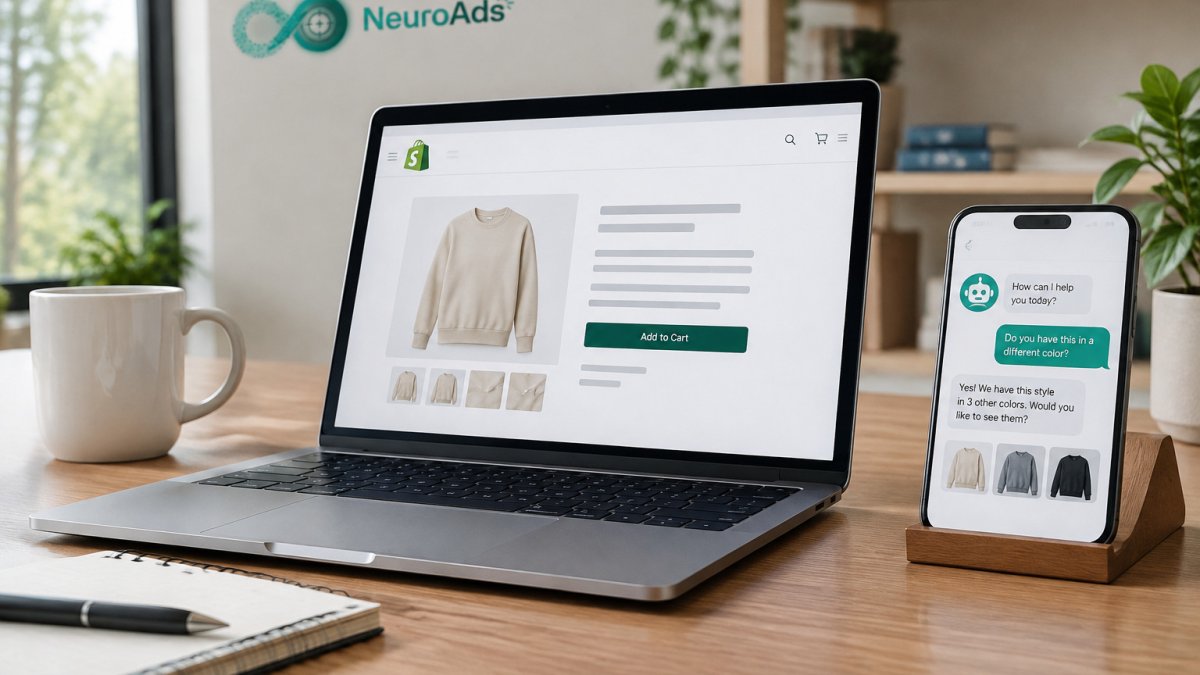
Bottom-funnel copy removes risk. In Shopify chat, the winning pattern is a short reassurance plus a question: the saved cart, the return window, the shipping promise. In SMS, keep it under 160 characters, name the deadline, and include the code. AI will happily write a 300-character SMS; trim it yourself.
Sales outreach and landing pages
For landing pages, prompt AI for a headline that restates the ad promise word for word, then a subhead that adds the proof. For sales outreach, prompt for a one-sentence reason you are writing, one relevant proof point, and one question. The same offer should never sound identical across all five channels, if it does, the model was given too little context.
The pattern is consistent: one channel, one stage, one job. For hands-on testing of these messages, read our guide to testing AI ad hooks, offers, and visuals.
AI Marketing Copy Prompts You Can Reuse
Vague prompts produce vague copy. Use templates with defined inputs, outputs, and evaluation criteria.
Prompt template: objection-led ad
- Inputs: segment, objection, product, proof point, tone
- Output: three headline variants, three body variants, one CTA
- Evaluation: does it name the objection in the first line? Is the claim verifiable?
Prompt template: cart recovery email
- Inputs: cart value, abandoned item, prior purchase history, return policy
- Output: subject line, 60-word body, one CTA
- Evaluation: does it remove one specific risk?
Run each prompt three times. Keep the variants that differ meaningfully, not just in wording.
AI Copywriting Best Practices: Human Review and Brand Voice
AI-generated claims still need to be truthful and not misleading. Crowell & Moring's summary of FTC guidance warns marketers against AI washing and stresses that using AI does not transfer responsibility for the claims made.
So build a review gate. Every AI draft passes through three checks:
- Factual: can every claim be verified?
- Brand voice: does it sound like us, not like a model?
- Compliance: are disclosures and substantiation in place?
For a broader view of brand voice and ROAS, see our guide on how ecommerce brands improve ROAS with AI.
AI Tools for Marketing Copy: What to Look For
Most AI tools for marketing copy generate text. Fewer connect that text to ad performance and store data. That gap is where ROAS gets lost.
When evaluating tools, score them on five criteria:
- Does it use behavioral and consented customer data?
- Can it map messages to funnel stages?
- Does it test copy against conversion, not clicks?
- Does it unify ad platforms and Shopify data?
- Does it support human review before publishing?
Brands using AI reportedly had conversion rates 30-40% higher than brands using one standard message for everyone, according to Attentive's 2026 comparison. The lesson is not "use AI." It is "use AI to tailor."
Step-by-Step: Build Your First AI Messaging Workflow
You can run this workflow in a week.

Step 1: Pick two segments. Choose one high-intent segment and one recovery segment, such as cart abandoners and repeat buyers. Write down the behavioral definition of each, for example, "added to cart in the last 24 hours and did not purchase", so the segment is reproducible.
Step 2: Assign one funnel stage per segment. Write it into the prompt. A cart abandoner is bottom of funnel; a first-time visitor is top.
Step 3: Draft with a template. Use the prompts above. Generate three variants per message and keep the ones that differ in angle, not just wording.
Step 4: Review for facts and voice. Cut any unverifiable claim.
Step 5: Launch as a controlled test. Change one variable: hook, offer, or CTA.
Step 6: Measure against conversion, not clicks. Compare click-through rate, conversion rate, and ROAS by variant. For email, measure revenue per recipient rather than open rate.
World of Wonder used AI optimization tools for its streaming service and saw conversions for RuPaul's Drag Race rise nearly 20%, per Unbounce's CRO case study roundup.
Connect Ad Clicks to Purchases With the AI Advertising Platform
Most messaging problems are really data problems. Copy gets written in one tool, tested in another, and measured somewhere else. The loop never closes.
The AI Advertising Platform from NeuroAds Inc. is designed to close that gap. It connects ad clicks to purchases through AI-powered ad optimization, predictive targeting, and cross-channel campaign management, producing smarter performance signals to inform your next message.
If your ROAS has stalled, start by fixing the targeting and conversion gaps, not the copy deck. Request a free growth audit to see how the AI Advertising Platform could work for your store.
Frequently Asked Questions
What is AI conversion-focused messaging?
It is the practice of using AI to write and adapt marketing messages around a specific action you want the reader to take, rather than around general brand awareness. The model is given a defined audience segment, a funnel stage, one primary objection, and a measurable goal. The CMO Survey reported AI in 24.2% of marketing activities in 2026, up from 13.1% in 2024, which means most teams now have the tooling. What separates good AI conversion work is the brief you feed it and the review step after it.
How do you prompt AI to write persuasive marketing messages?
Give the model five inputs in one prompt: the audience segment and what they already know, the funnel stage, the single objection to answer, the proof points you can legally support, and the format constraints such as character count. Ask for five variants, not one. Then ask it to label each variant with the objection it addresses so you can compare them in testing. Vague prompts produce generic copy, and generic copy is what makes AI-written ads underperform.
How can you test AI-generated marketing messages?
Test one variable at a time: the objection, the proof point, or the call to action, never all three in the same variant. Run each variant long enough to clear your normal conversion volume before calling a winner, and record the baseline first. Be careful with attribution claims. Traffic-source comparisons measure where visitors come from, not the effect of AI-written copy. Treat messaging tests as their own measurement track.
How do you keep AI-generated marketing copy accurate and on-brand?
Build a review gate before anything ships. Give the model an approved fact sheet with product claims, shipping terms, and return policy, and instruct it to use only those facts. Have a human check every claim against that sheet, because the FTC holds marketers responsible for AI-generated advertising claims being truthful and not misleading. Add three to five sample messages that sound like your brand as reference, and reject any output that invents a statistic, a discount, or a guarantee you did not supply.