 blog
Is an AI Performance Advertising Platform Worth It?
Last Updated: November 1, 2026
Quick Summary
An AI performance advertising platform is worth it when its optimization improves incremental revenue, not just reported ROAS. Test incrementality with holdout or geo-split tests, model total cost of ownership, and confirm human oversight before you trust AI performance advertising with budget decisions.
- 63% of marketers now use generative AI, and tools increasingly handle optimization themselves.
- AI-generated ads were almost indistinguishable from human-made work but did not perform as well.
- 46% of marketers use AI to scale creative and 33% run AI across creative, media, and measurement.
- Brands using AI creative generation see 30-60% higher click-through rates than manual ads.
- Score vendors on measurement quality, cost, coverage, oversight, and privacy before signing.
Table of Contents
- What an AI Performance Advertising Platform Actually Does
- Where AI Advertising Tools Deliver and Where They Fall Short
- AI Ad Optimization: Bids, Budgets, and Creative Testing
- AI-Powered Audience Targeting Without the Guesswork
- Return on Ad Spend Optimization: What Moves the Number
- How to Evaluate an AI Performance Advertising Platform
- Start Optimizing with the NeuroAds AI Advertising Platform
- Frequently Asked Questions
What an AI Performance Advertising Platform Actually Does
An AI performance advertising platform is software that uses machine learning to plan, buy, and optimize paid media across channels, adjusting bids, budgets, and creative based on live performance signals rather than static rules.
NeuroAds Inc. takes a conversion-first approach: paid traffic only counts if it turns into profitable customers.
Here is the short version of what these platforms do:
- Bid optimization: adjust bids in near real time based on predicted conversion probability
- Budget allocation: shift spend toward campaigns and channels producing revenue
- Creative testing: rotate and score ad variants automatically
- Audience targeting: build and refresh segments from behavioral signals
- Attribution and reporting: tie spend to outcomes across channels
The value is not the automation itself. It is whether the automation reads your data accurately enough to make better calls than a human media buyer could at the same speed.
Where AI Advertising Tools Deliver and Where They Fall Short
AI advertising tools are strongest at scale and weakest at judgment. They process more signals, test more variants, and adjust faster than any team can manually.
That gap matters. Automation without brand judgment can produce ads that look fine and convert poorly. The platforms that work well pair machine optimization with human oversight on messaging, claims, and brand safety.
Where these tools deliver:
- Faster iteration on bids and budgets than manual management allows
- Consistent testing volume across channels
- Earlier detection of underperforming campaigns
Where they fall short:
- Creative that lacks a real point of view
- Attribution that overstates credit to the last click
- Optimization toward the wrong goal if the conversion event is misconfigured
The practical takeaway: point the AI at the right metric, and review its creative output before it scales.
AI Ad Optimization: Bids, Budgets, and Creative Testing
AI ad optimization works by predicting which combinations of bid, audience, and creative will produce the best return, then reallocating spend toward them.
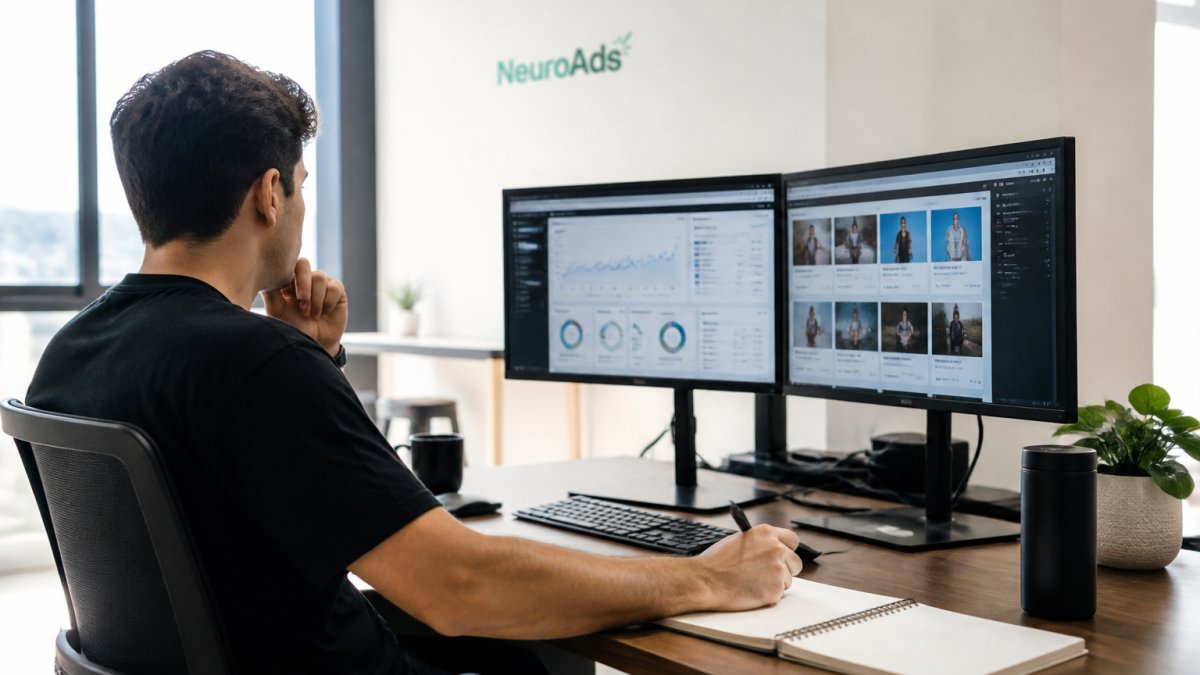
Bids and budgets are the easiest levers to automate. For hands-on steps, follow the NeuroAds creative testing how-to guide.
Watch out: if your conversion event fires on page views instead of purchases, the platform will optimize toward traffic, not revenue. Check the event setup before you trust the numbers.
AI-Powered Audience Targeting Without the Guesswork
AI-powered audience targeting replaces manual segment building with predictive models that score shoppers on likelihood to convert. The NeuroAds smart targeting guide shows how this approach works in practice.
Audience segmentation still needs a human decision about who you want to reach. The AI handles the execution: excluding low-intent traffic, expanding lookalikes from your best customers, and adjusting frequency so you do not burn out a segment.
Return on Ad Spend Optimization: What Moves the Number
Return on ad spend optimization comes down to three levers: conversion rate, cost per acquisition, and average order value. To understand the mechanics behind the lift, read how an AI ad optimization platform actually improves ROAS. AI can influence all three, but conversion rate is usually the biggest swing. Omneky's AI advertising statistics reports that brands using AI creative generation see 30-60% higher click-through rates than manually designed ads.
Higher click-through helps, but clicks are not revenue. The platforms that lift ROAS connect ad performance to on-site behavior, including the moment a shopper hesitates before checkout. The NeuroAds platform pairs ad optimization with an integrated Shopify chatbot that handles objections and recovers shoppers before they leave the store.
| Lever | What AI Changes | Where Teams Get It Wrong |
|---|---|---|
| Conversion rate | Tests landing and offer variants faster | Optimizing to clicks, not purchases |
| Cost per acquisition | Reallocates budget to efficient segments | Ignoring margin per product |
| Average order value | Promotes bundles to likely buyers | Pushing discounts that erode margin |
Measure incrementality before you trust the number
Reported ROAS is an attribution output, not a causal result. A campaign can show a strong ROAS while most of those conversions would have happened anyway. To separate incremental revenue from credited revenue:
- Run holdout or geo-split tests on your largest campaigns and compare treated and untreated groups.
- Set attribution windows per channel; a short window undercredits upper-funnel work and a long window overcredits it.
- Split new-customer and returning-customer conversions so you can see which spend actually acquires demand.
A common pattern is that prospecting campaigns look weak on last-click ROAS and strong on incremental new-customer revenue, while retargeting looks the opposite. Optimizing to last-click alone will systematically underfund prospecting.
AI Performance Marketing Platform →
Use margin-adjusted ROAS, not revenue ROAS
Revenue ROAS treats a dollar of high-margin product the same as a dollar of a low-margin one. Margin-adjusted ROAS divides gross profit, not revenue, by ad spend. Build a product-level margin file and feed it into your optimization target so the platform favors profitable SKUs instead of high-revenue, low-margin ones. Teams that skip this step often scale a product that grows revenue and shrinks profit.
Set the right conversion event
The single biggest ROAS failure is optimizing toward the wrong event. If your conversion event fires on page views or add-to-cart instead of purchases, the platform will optimize toward traffic. Verify the event setup, deduplicate events, and confirm that purchase value and currency pass correctly before you trust the numbers.
Connect ad data to on-site behavior
ROAS improves when the platform can see what happens after the click. Connecting ad data to store behavior, cart events, and support conversations lets the model learn which audiences convert and which need a nudge. The integrated Shopify chatbot handles objections and recovers shoppers before they leave the store.
Review creative and claims before scaling
AI can generate variants at volume, but it cannot judge whether a claim is accurate or on-brand. Put an approval step between generation and scale, and cap budgets on new creative until it proves out.
How to Evaluate an AI Performance Advertising Platform
Evaluating an AI performance advertising platform means testing whether its optimization actually improves incrementality, not just reported ROAS. For a structured comparison checklist, see the AI advertising platform buyer's guide for DTC brands. Most platforms can show a dashboard that looks good. Fewer can prove the lift came from their decisions. The sections below give you a scoring method, a cost model, and a set of questions that separate evidence-led platforms from promotional ones.
Score platforms on five weighted criteria
Use a simple 100-point score so you can compare vendors apples to apples instead of ranking them by demo polish. A common weighting that holds up across business sizes:
| Criterion | Weight | What to verify |
|---|---|---|
| Measurement quality | 25 | Incrementality testing, attribution windows, holdout support |
| Total cost of ownership | 20 | Ad-spend-based fees, seat limits, creative credits, onboarding |
| Channel and data coverage | 20 | Every channel you run, plus store and email connections |
| Human oversight and brand safety | 20 | Approval workflows, claim checks, budget caps |
| Privacy and data governance | 15 | Consent handling, retention, data access scope |
Score each vendor on a 1-5 scale per criterion, multiply by the weight, and sum. A platform that scores well on dashboards but poorly on measurement quality will usually lose once you run the math.
Test incrementality, not just attributed revenue
Attribution tells you which touchpoints were present before a conversion. Incrementality tells you which conversions would not have happened without the ad. Ask every vendor three questions:
- Can it run a holdout or geo-split test, and how long does a test need to reach a confident read?
- What attribution window does it default to, and can you change it per channel?
- How does it separate new-customer conversions from returning-customer conversions that would have happened anyway?
A platform that cannot answer these is optimizing toward last-click credit, which overstates paid media and understates organic and email. Most practitioners find that last-click models overcredit lower-funnel channels and starve upper-funnel prospecting.
Model total cost of ownership before you sign
Starting prices rarely reflect what you actually pay. Build a 12-month cost model that includes:
- Platform fee: flat, percentage of ad spend, or hybrid
- Ad-spend-based fees: the percentage that kicks in above a spend threshold
- Seat limits: what each additional user costs
- Creative credits: how many AI-generated variants are included and what overages cost
- Onboarding and migration: setup, pixel and event work, historical data import
- Staff time: hours per week to manage the tool, review creative, and reconcile reporting
- Minimum budgets: required monthly ad spend to stay on the plan
A lower headline fee with a spend-based surcharge and tight seat limits often costs more at scale than a flat fee. Model it at your current spend and at 2x your spend before deciding.
Check privacy, consent, and data governance
Measurement quality depends on data access, and data access depends on consent. Ask how the platform handles consent signals, what it retains and for how long, and whether it can measure without relying on third-party cookies. Confirm that ad account access is scoped and revocable, and that store data stays under your control.
Confirm human oversight and failure safeguards
AI fails in predictable ways: inaccurate claims, off-brand creative, budget overspend, and unsafe placements. Ask for approval workflows before creative scales, hard budget caps, claim and compliance checks, and placement exclusion lists. A platform without these safeguards will eventually spend money you did not approve.
Run a 30-day pilot with defined success criteria
Set the metric, the baseline, and the threshold before the pilot starts. A workable structure: pick one channel and one campaign objective, define the conversion event, agree on the incrementality test, and set a decision date. Ask what happens in the first 30 days if performance does not improve, and get the answer in writing.
Start Optimizing with the NeuroAds AI Advertising Platform
The hard part of AI performance advertising is not adopting a tool. It is trusting the tool with the decisions that move revenue, and that trust has to be earned with evidence.
NeuroAds Inc. offers an AI Advertising Platform for DTC and e-commerce brands. It combines AI ad optimization and predictive targeting with an integrated Shopify AI Chatbot that handles objections and recovers shoppers before checkout. Cross-channel campaign management is part of the platform.
Frequently Asked Questions
What is an AI performance advertising platform?
It is software that uses machine learning to run paid campaigns: setting bids, allocating budget, testing creative, and adjusting audience targeting based on performance signals. Instead of a media buyer manually tweaking dozens of ad sets, the platform monitors results and reallocates spend toward what converts. Most tools connect to channels like Meta Ads, Google, and TikTok, then report back in one dashboard. The value depends on how clean your conversion tracking is and how much human oversight you keep on brand and creative decisions.
How do AI advertising tools measure return on ad spend?
They divide attributed revenue by ad spend, but the number is only as good as the attribution behind it. Platforms pull conversion data from pixels, server-side tracking, and your store's order data, then assign credit to campaigns. Ask whether the tool uses last-click or a modeled approach, and whether it reconciles with your Shopify or backend revenue. Run a holdout test on one channel to see how reported ROAS compares with actual incremental sales before you trust the dashboard number.
Are AI performance advertising platforms suitable for smaller e-commerce brands?
They can be, if the platform fits your spend level and integrates with your existing stack. A brand spending a few thousand dollars a month needs fast setup and clear reporting more than enterprise-grade automation. Check for a free plan or trial, confirm native Shopify integration, and ask how much manual configuration the onboarding requires. Tools that only pay off at six-figure monthly budgets will not earn their keep for a lean team, so match the platform to your actual volume.
Can AI really improve return on ad spend optimization?
It can, but not automatically. AI handles the repetitive work well: bid adjustments, budget pacing, audience segmentation, and creative variant testing at a speed no team can match manually. The gains come from combining that automation with human judgment on offer, positioning, and brand safety. Treat AI output as a starting point, not a finished campaign.