 how-to
AI Chatbot for Objection Handling: A 2026 Guide
Table of Contents
- What Is AI Chatbot for Objection Handling?
- How AI Chatbots Detect and Respond to Objections in Real-Time
- AI Sales Objection Scripts: Building Effective Response Frameworks
- Overcoming Price Objections in E-Commerce with AI
- Automated Customer Recovery Tools: From Cart Abandonment to Conversion
- Measuring ROI: Key Metrics for AI Objection Handling
- Implementing AI Objection Handling Without Disrupting Your Team
- Conclusion
Last Updated: August 28, 2026
What Is AI Chatbot for Objection Handling?
An AI chatbot for objection handling is an intelligent system that detects customer hesitations during the sales process and delivers real-time, contextually appropriate responses to overcome them. Unlike generic chatbots that follow rigid scripts, these systems use natural language processing and machine learning to analyze what customers are actually saying, their concerns, and emotional cues, then surface the most relevant counterargument at precisely the moment it's needed.
A standard chatbot might recognize the word "price" and push a discount. An AI chatbot for objection handling understands that "your product is too expensive" might signal concerns about ROI, implementation time, or competitive alternatives, and responds differently to each.
AI-powered chatbots can resolve a significant percentage of routine customer queries (gartner.com). For e-commerce brands, this means intercepting cart abandonment before it happens. For B2B sales teams, it means equipping reps with instant talking points during high-stakes calls.
How AI Chatbots Detect and Respond to Objections in Real-Time
Detection starts with listening. Modern AI systems analyze live conversation in real-time, scanning for linguistic patterns that signal hesitation: "I'm not sure," "How does this compare," or silence gaps that suggest uncertainty.
What distinguishes this from keyword-matching is context layering. The system weighs sentence structure, tone markers, conversation history, and customer profile data to determine whether an objection signals a budget constraint, value perception issue, or competitive comparison shopping. Each diagnosis triggers a different response pathway.
Sales teams using AI-driven conversation intelligence can see an increase in win rates (gong.io). When a customer raises an objection, the system surfaces three to five potential responses ranked by relevance, allowing the sales rep or chatbot to deliver the best fit while the conversation is still live.
For e-commerce, this manifests as cart recovery. A shopper hesitates at checkout, perhaps comparing prices, worried about shipping, or uncertain about product fit. The AI chatbot detects the hesitation pattern and offers targeted assistance: a shipping calculator, customer reviews addressing their concern, or a limited-time offer if price sensitivity is detected.
Research shows that a majority of consumers prefer digital self-service for simple tasks. An AI chatbot that handles objections smoothly feels like self-service to the customer, delivering answers instantly without feeling like a sales pitch.

AI Sales Objection Scripts: Building Effective Response Frameworks
Effective objection scripts aren't rigid. They're response templates with variable slots, frameworks that adapt to the specific objection while maintaining your brand voice and value proposition.
Start by mapping your top 10 objections. For most e-commerce brands, these cluster into four categories: price concerns, product uncertainty, competitive alternatives, and trust gaps. For B2B, add implementation complexity and ROI validation. Document how your best sales reps currently handle each one, capturing the underlying logic and key points rather than word-for-word scripts.
The AI system learns from these templates. It doesn't generate responses from scratch; it learns which frameworks work best for which objection types, then generates natural variations in context. A script that works for a first-time visitor won't work for someone who's visited your site five times. The AI knows the difference.
Build your scripts around these principles:
- Acknowledge before countering. "I hear that price is a concern" lands differently than jumping straight to justification.
- Provide specific proof. "Customers like you see ROI within 90 days" beats "most customers are happy."
- Offer an escape route. If the objection is a genuine deal-breaker, let the customer self-select out. Forcing a sale kills lifetime value.
- Match objection complexity to response depth. A one-sentence concern gets a two-sentence answer. A multi-part objection gets a structured response.
The best scripts are built from your actual customer data. If you don't know what objections your customers are raising, you're guessing.
Overcoming Price Objections in E-Commerce with AI
Price objections are the most common blocker in e-commerce, and they're often misdiagnosed. When a customer says "your product is too expensive," they rarely mean the absolute price. They mean the perceived value-to-price ratio doesn't justify the purchase decision right now.
An AI chatbot for objection handling addresses this by reframing. Instead of defending price, it builds value context. If the customer is viewing a premium product, the system might surface testimonials from similar buyers, detailed product comparisons showing feature advantages, or financing options that reduce the psychological burden of upfront cost.
Websites using chatbots can see an increase in conversion rates, with some of that lift coming from real-time objection handling during checkout (gartner.com). More specifically, AI-driven proactive chats can recover a notable percentage of abandoned carts, many abandoned precisely because price objections weren't addressed.
For price objections, AI systems deploy several proven tactics:
- Anchoring against alternatives. Show how your price compares to competitors (favorably) without being defensive.
- Bundling and tiering. Offer multiple price points. A customer who won't buy at $99 might buy at $49 or $149 if the higher tier offers clear additional value.
- Value decomposition. Break down what the customer is actually paying for. "$200 for a tool that saves 10 hours per week" is a different mental calculation than "$200 for software."
The AI system learns which tactic works best for which customer segment. A first-time buyer might need value education. A returning customer price-comparing might need a loyalty discount. The system routes each to the appropriate response framework in real-time.
Automated Customer Recovery Tools: From Cart Abandonment to Conversion
Cart abandonment is the e-commerce equivalent of a prospect going silent on a sales call. Something stopped the customer mid-decision. The question is whether you can recover them before they leave.
Automated customer recovery tools powered by AI chatbots operate on a simple principle: intervene early, diagnose the objection, and offer a targeted solution. This happens in real-time for web visitors and post-abandonment via email or SMS for those who've already left.
A customer adds items to cart but doesn't proceed to checkout. After 30-60 seconds of inactivity, a chat window appears: "I noticed you're interested in [product]. Any questions I can help with?" If the customer responds, the AI chatbot analyzes their concern. If they don't, the system tags them for email follow-up with a targeted recovery message.
Data shows that AI chat can increase conversions significantly. For cart recovery specifically, AI-driven proactive chats can recover a notable percentage of abandoned carts.
Why does this work? Abandoned carts usually signal one of three things: shipping confusion, payment concerns, or last-minute price hesitation. A well-trained AI chatbot addresses all three in seconds.
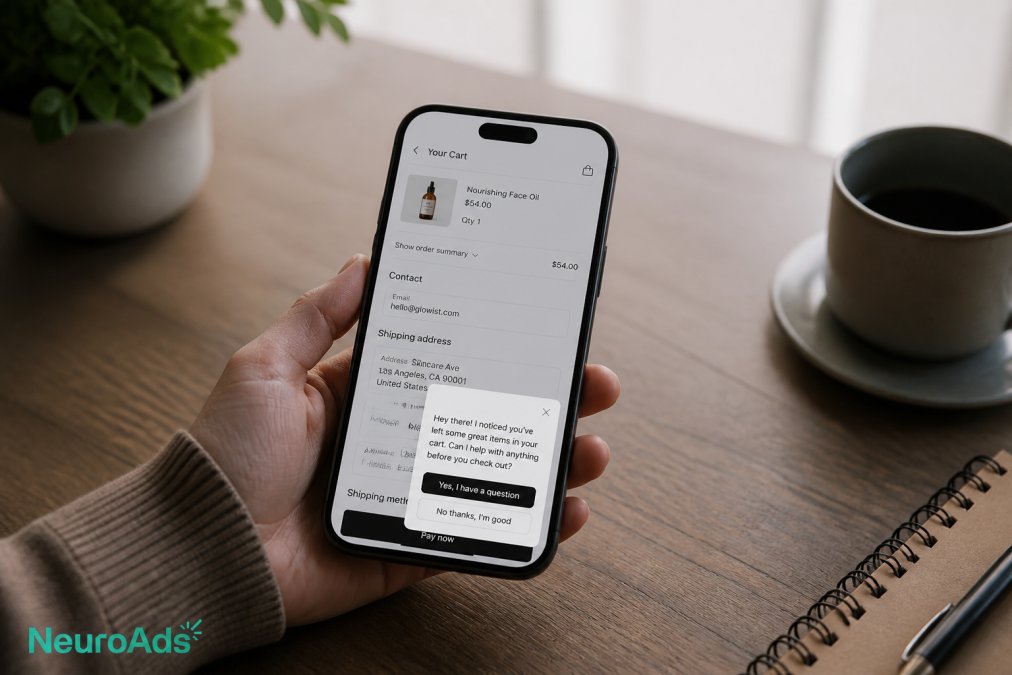
Implementation matters. The chatbot needs access to cart contents, customer history, and your product catalog to give contextual answers. It needs to know your shipping policies, return windows, and available discounts so it can address objections with real information.
For B2B, the same principle applies to sales pipeline recovery. A prospect goes quiet after an initial demo. An AI system can trigger targeted outreach: "I noticed you downloaded our case study but didn't schedule a follow-up. What questions came up?" This keeps the deal warm without pestering.
The key differentiator is intelligence. A basic automation system sends the same recovery email to everyone. An AI system sends different messages to different segments based on what objections they're most likely to have.
Measuring ROI: Key Metrics for AI Objection Handling
ROI measurement for AI objection handling requires looking beyond surface metrics. Yes, you want to track conversion rate lift. But the real value emerges when you measure what's changed in your sales process itself.
Start with these core metrics:
Conversion rate by objection type. Track what percentage of customers who raise a specific objection (price, product fit, competitor comparison) ultimately convert. This tells you which objections your current responses handle well and which need refinement.
Time to resolution. How long does it take from objection raised to customer decision? AI systems should compress this significantly. If your average sales cycle was 7 days and it's now 3 days, that's ROI in pipeline velocity alone.
Win rate improvement. Sales organizations that provide sellers with AI-enabled next best actions are more likely to achieve commercial growth.
Customer satisfaction and NPS. Better objection handling should improve how customers feel about the buying experience. A customer who gets their concern addressed feels heard.
Cost per acquisition (CPA) trend. If you're recovering more abandoned carts and accelerating sales cycles, your CPA should improve.
Sales rep ramp-up time. New reps using AI objection handling systems typically reach productivity faster, reducing onboarding costs.
For e-commerce specifically, measure cart recovery rate, average order value on recovered carts, and customer lifetime value of recovered customers.
Implementing AI Objection Handling Without Disrupting Your Team
The biggest implementation risk isn't technical, it's adoption. Your team needs to trust the AI system, understand how to use it, and feel like it's making their job easier, not replacing them.
Start small. Pick one channel (chat, email, or live sales calls) and one use case (cart abandonment, price objections, or lead qualification). Get that working well before expanding.
Next, involve your team in building the objection frameworks. Ask your best sales reps and customer service agents what objections they hear most and how they currently handle them. Use that as the foundation. The AI learns from their expertise; they see themselves reflected in the system.
Training matters more than most teams expect. Your team needs to understand what the system is doing, why it's suggesting certain responses, and when to override it. Ongoing training and regular feedback reviews are essential.
The implementation roadmap looks like this:
- Week 1-2: Map your top objections and current handling approaches
- Week 3-4: Build initial response frameworks with your team
- Week 5-6: Deploy to one channel with a small segment (10-20% of traffic)
- Week 7-8: Monitor, collect feedback, refine
- Week 9-10: Expand to full channel rollout
- Week 11+: Expand to additional channels or use cases
Hybrid workflows beat pure automation. The best implementations use AI to handle routine objections and escalate complex ones to humans. A customer with a nuanced concern gets routed to a real person. This preserves customer experience while freeing your team to focus on high-value interactions.
Conclusion
The global chatbot market is projected to grow significantly in the coming years. That growth is driven by the tangible business impact of AI systems that actually improve how companies engage with customers.
An AI chatbot for objection handling isn't a luxury anymore. It's the difference between recovering abandoned revenue and losing it, between accelerating sales cycles and watching them drag. Companies using AI for customer service can see an improvement in customer satisfaction, and sales teams using AI-driven conversation intelligence can see increases in win rates.
The challenge isn't whether to implement this, it's how to do it in a way that your team actually adopts and your customers actually appreciate. Start with the Shopify AI Chatbot (https://apps.shopify.com/neuroads-chatbot), which integrates directly into your store to handle objections at the moment customers are most likely to abandon. Pair it with the AI Advertising Platform (https://app.neuroadsinc.com) to ensure your paid traffic reaches the right audiences while your chatbot recovers those on the fence. Together, they close the gap between ad click and purchase, turning skeptical visitors into confident buyers.
=== FAQ ANSWERS (audit these too, same rules) ===
[1] Q: How can AI chatbots handle complex customer objections in real-time? A: AI chatbots use natural language processing and machine learning to analyze customer messages, identify objections, and surface contextually relevant responses within seconds. They recognize patterns in objections, like price concerns, competitor comparisons, or technical hesitations, and match them to proven resolution scripts. For complex scenarios that exceed the chatbot's confidence threshold, the system escalates to a human agent, ensuring customers get expert help when needed. This hybrid approach can resolve a significant percentage of routine queries automatically while preserving quality for high-value conversations.
[2] Q: What are the key benefits of using AI for objection handling in e-commerce? A: AI chatbots for objection handling deliver measurable business results: companies using AI for customer service can see an improvement in customer satisfaction, while websites using chatbots can experience an increase in conversion rates. For abandoned carts specifically, AI-driven proactive chats can recover a notable percentage of lost transactions. Sales teams using AI objection handling can see increases in win rates. Beyond metrics, AI provides 24/7 availability, reduces response latency, and frees your team to focus on high-value deals instead of repetitive objection handling.
[3] Q: Can AI chatbots completely replace human sales agents for objection handling? A: No. AI chatbots excel at handling routine objections, price questions, product feature clarifications, delivery timelines, but enterprise buyers and complex sales require human judgment. Chatbots lack the situational awareness to navigate nuanced stakeholder dynamics or build consultative relationships. The most effective approach is hybrid: AI handles a large percentage of initial objections and qualification, escalating high-complexity or high-value conversations to your team. This maximizes efficiency while preserving the trust and expertise that close deals.
[4] Q: What metrics should you track when using AI for objection handling? A: Track four categories: resolution metrics (objection resolution rate, escalation rate), business impact (conversion rate lift, cart recovery rate, average order value), customer experience (response time, satisfaction score, resolution time), and team efficiency (time saved per agent, volume handled per day). The most important metric depends on your goal, if you're optimizing for revenue, focus on conversion lift and cart recovery. If scaling support, measure volume handled and escalation rate.
Frequently Asked Questions
Q: How can AI chatbots handle complex customer objections in real-time?
A: AI chatbots use natural language processing and machine learning to analyze customer messages, identify objections, and surface contextually relevant responses within seconds. They recognize patterns in objections, like price concerns, competitor comparisons, or technical hesitations, and match them to proven resolution scripts. For complex scenarios that exceed the chatbot's confidence threshold, the system escalates to a human agent, ensuring customers get expert help when needed. This hybrid approach can resolve a significant percentage of routine queries automatically while preserving quality for high-value conversations.
Q: What are the key benefits of using AI for objection handling in e-commerce?
A: AI chatbots for objection handling deliver measurable business results: companies using AI for customer service can see an improvement in customer satisfaction, while websites using chatbots can experience an increase in conversion rates. For abandoned carts specifically, AI-driven proactive chats can recover a notable percentage of lost transactions. Sales teams using AI objection handling can see increases in win rates. Beyond metrics, AI provides 24/7 availability, reduces response latency, and frees your team to focus on high-value deals instead of repetitive objection handling.
Q: Can AI chatbots completely replace human sales agents for objection handling?
A: No. AI chatbots excel at handling routine objections, price questions, product feature clarifications, delivery timelines, but enterprise buyers and complex sales require human judgment. Chatbots lack the situational awareness to navigate nuanced stakeholder dynamics or build consultative relationships. The most effective approach is hybrid: AI handles a large percentage of initial objections and qualification, escalating high-complexity or high-value conversations to your team. This maximizes efficiency while preserving the trust and expertise that close deals.
Q: What metrics should you track when using AI for objection handling?
A: Track four categories: resolution metrics (objection resolution rate, escalation rate), business impact (conversion rate lift, cart recovery rate, average order value), customer experience (response time, satisfaction score, resolution time), and team efficiency (time saved per agent, volume handled per day). The most important metric depends on your goal, if you're optimizing for revenue, focus on conversion lift and cart recovery. If scaling support, measure volume handled and escalation rate.
This article was written using GrandRanker