
 how-to
How to Improve Ecommerce ROAS in 2026
Table of Contents
- Ecommerce ROAS Benchmarks 2026: Where Do You Actually Stand?
- Fix Attribution Windows Before You Touch Your Ad Spend
- Reducing Ad Spend Waste Through Smarter Audience Segmentation
- AI-Powered Ad Optimization Tools That Move the ROAS Needle
- Conversion Rate Optimization for Ecommerce: Closing the Gap Between Click and Purchase
- Post-Purchase Experience: The ROAS Multiplier Most Brands Ignore
- Full-Funnel Strategy: Connecting Every Stage to Profitability
- Frequently Asked Questions
Last Updated: August 18, 2026
Ecommerce ROAS Benchmarks 2026: Where Do You Actually Stand?
Ecommerce ROAS is the single most important efficiency metric in paid media, and most brands are measuring it wrong. At NeuroAds Inc., we track performance across hundreds of DTC campaigns, and the pattern is consistent: brands that struggle to scale aren't just underperforming on ROAS, they're benchmarking against the wrong numbers entirely.
Ecommerce ROAS is defined as the revenue generated for every dollar spent on advertising. A ROAS of 3x means three dollars returned for every dollar invested in paid media.
What counts as a healthy benchmark in 2026 depends heavily on your margin structure, channel mix, and customer acquisition cost relative to lifetime value. A brand with 70% gross margins can profitably run at 2x ROAS. A brand with 30% margins needs 4x or higher just to break even on paid acquisition. Benchmarking against industry averages without accounting for your own unit economics is one of the fastest ways to make bad budget decisions.
Here's what the current landscape looks like across channels, based on Google's performance benchmarks for retail advertisers:
- Search: Typically the highest-intent channel, often delivering the strongest direct ROAS
- Social (Meta, TikTok): More variable, heavily dependent on creative quality and audience segmentation
- Display/Programmatic: Lower direct ROAS, but critical for full-funnel awareness
The most useful benchmark is your own blended ROAS trend over time, combined with marginal ROAS on incremental spend. If adding budget to a campaign returns less than your average, you've hit the efficiency ceiling for that audience.
| Metric | What It Measures | When to Use It |
|---|---|---|
| Blended ROAS | Total revenue / total ad spend | Overall efficiency snapshot |
| Marginal ROAS | Revenue from next $1 of spend | Scaling and budget decisions |
| Marketing Efficiency Ratio | Revenue / all marketing costs | Full-funnel profitability |
Fix Attribution Windows Before You Touch Your Ad Spend
Most ROAS problems aren't ad problems. They're attribution problems.
Before adjusting bids, cutting budgets, or testing new creatives, verify that your attribution windows are set up correctly across every platform. Mismatched windows between Meta, Google, and your Shopify analytics create phantom performance gaps where campaigns look unprofitable but are actually driving revenue that isn't being credited correctly.
Blended ROAS vs. Marginal ROAS: Which Number to Trust
The number to trust depends on the decision you're making. Blended ROAS gives you a health check on overall campaign performance. Marginal ROAS tells you whether scaling a specific campaign will be profitable or destructive.
A common mistake is chasing a high blended ROAS by cutting low-ROAS campaigns that are actually driving incremental revenue through assisted conversions. Removing a top-of-funnel prospecting campaign because it shows 1.5x direct ROAS can collapse the entire funnel within 30 to 60 days. The math on marginal ROAS saves you from that error.
Privacy-First Measurement: Server-Side Tracking and First-Party Data
Browser-based tracking pixels are losing signal fast. iOS privacy changes and third-party cookie deprecation have created systematic undercounting across Meta and Google campaigns, meaning your reported ROAS is likely higher than your actual ROAS.
The fix is server-side tracking combined with a first-party data strategy. Server-side tracking routes conversion events through your own server before sending them to ad platforms, bypassing browser-level blocking. This restores data integrity and gives ad platform algorithms accurate signals to optimize against.
According to IAB's guidance on privacy-preserving measurement, first-party data collected through owned channels, email, SMS, loyalty programs, is now the foundation of durable measurement strategies. Brands that have built first-party data assets are significantly less exposed to signal loss than those still relying entirely on pixel-based tracking.
Reducing Ad Spend Waste Through Smarter Audience Segmentation
The biggest source of ad spend waste isn't bad creatives or wrong channels. It's targeting the wrong people with the right message.
Audience segmentation determines whether your ad inventory is being spent on high-intent buyers or low-probability browsers. Most brands segment too broadly, relying on platform-defined interest categories that have become increasingly imprecise as privacy restrictions limit behavioral data.
Effective segmentation in 2026 requires layering:
- Purchase intent signals, site behavior, product page depth, cart activity
- Recency and frequency, how recently and how often a user has engaged
- Lifetime value tiers, separating high-LTV customer profiles from one-time buyers
- Lookalike modeling, built from first-party customer lists, not platform defaults
Retargeting vs. Prospecting: Allocating Budget Where It Converts
Retargeting almost always shows higher direct ROAS than prospecting. This is expected, you're reaching people who already know your brand. The mistake is over-indexing on retargeting to the point where you're burning budget on users who would have converted organically anyway.
A practical allocation framework: retargeting audiences should be capped at the size that represents genuinely incremental conversions. If your retargeting audience is larger than your actual site visitor volume over the attribution window, you're likely overlapping with organic converters and inflating reported ROAS.
Prospecting campaigns drive customer acquisition cost efficiency over time by expanding the pool of high-intent users. They rarely show strong direct ROAS on a 7-day window, but brands that eliminate prospecting to protect short-term ROAS consistently see customer acquisition cost rise 60 to 90 days later as the retargeting pool shrinks.
AI-Powered Ad Optimization Tools That Move the ROAS Needle
Manual bid management and creative rotation can't keep pace with the speed at which ad platform algorithms update. AI-powered ad optimization works by continuously analyzing campaign performance signals, conversion rates, cost-per-click, audience overlap, creative fatigue, and adjusting bids and targeting in near real-time.

NeuroAds Inc. is built specifically for this problem. The platform combines predictive targeting with cross-channel campaign management, giving DTC brands a unified view of performance across Meta, Google, TikTok, and Pinterest, without the manual overhead of managing each platform separately. The AI identifies which audience segments and creatives are approaching diminishing returns and reallocates spend before efficiency degrades.
The thing most brands miss when evaluating AI optimization tools: the quality of the output is only as good as the quality of the input signals. Garbage tracking data produces garbage optimization. This is why fixing attribution windows and server-side tracking (covered above) is a prerequisite, not an afterthought.
Creative Testing Frameworks: What to Test and When to Scale
Creative fatigue is one of the fastest killers of ecommerce ROAS. An ad that performs well in week one can become invisible by week three as frequency increases and the algorithm exhausts the responsive audience.
A structured creative testing framework removes guesswork from this process:
- Isolate one variable at a time, hook, format, offer, or visual style
- Set a minimum spend threshold before making decisions, low-spend tests produce statistically unreliable signals
- Define scale criteria in advance, specify the ROAS threshold and volume floor that trigger scaling
- Rotate winners into evergreen campaigns, don't let a high-performing creative run until it collapses
Conversion Rate Optimization for Ecommerce: Closing the Gap Between Click and Purchase
Improving ecommerce ROAS doesn't always require better ads. Often, the fastest gains come from improving what happens after the click.
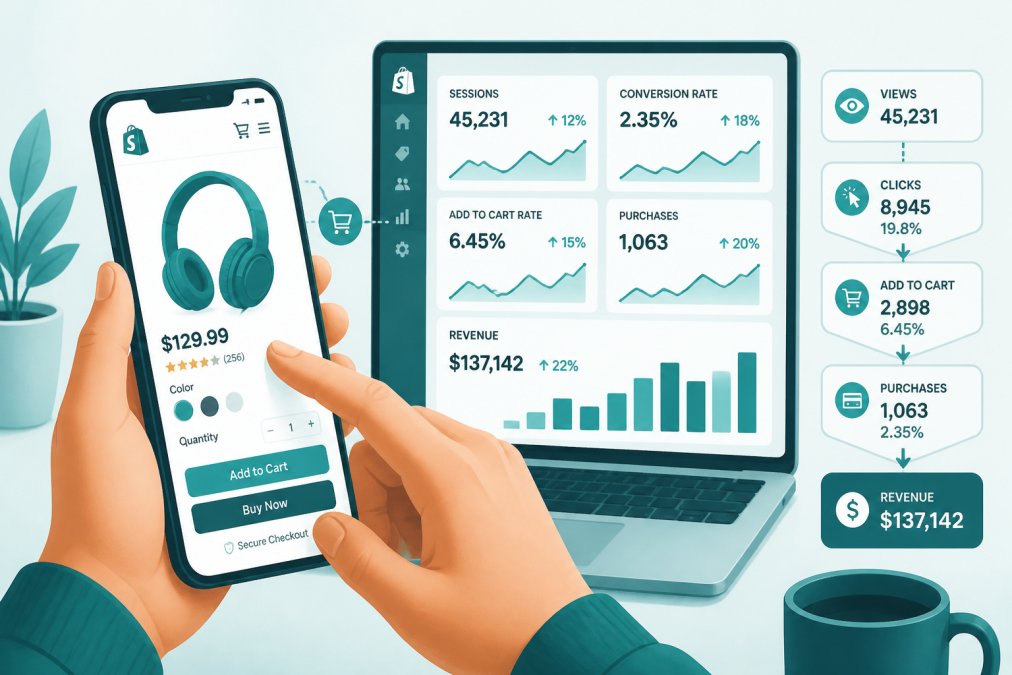
Conversion rate optimization for ecommerce is the practice of systematically identifying and removing the barriers that prevent site visitors from completing a purchase. A 1% improvement in conversion rate has the same ROAS impact as a significant reduction in cost-per-click, without increasing ad spend at all.
The conversion gap, the difference between click-through rate and purchase rate, tells you exactly how much revenue you're leaving on the table from your current traffic.
Friction Reduction: Checkout, Page Speed, and Objection Handling
Three friction points account for the majority of conversion gaps in ecommerce:
Checkout friction: Every additional step in the checkout process reduces conversion probability. Guest checkout, address autofill, and one-click payment options directly impact completion rates. According to Baymard Institute's ecommerce checkout research, the average checkout abandonment rate is well above 60%, with form complexity and forced account creation among the top causes.
Page speed: Load time directly affects both conversion rate and Quality Score on Google Ads, which in turn affects cost-per-click. Slower pages cost more to advertise and convert fewer visitors, a double penalty on ROAS.
Objection handling: Most product pages present information but don't resolve objections. Shoppers abandon when they're uncertain about sizing, returns, shipping timelines, or product quality. The NeuroAds Inc. Shopify chatbot addresses this directly, it handles real-time objections during the browsing and checkout process, capturing shoppers who would otherwise leave without purchasing.
Post-Purchase Experience: The ROAS Multiplier Most Brands Ignore
Here's the angle almost every ROAS guide misses: customer acquisition cost is only half the equation. The other half is how much revenue each acquired customer generates over their lifetime.
Post-purchase experience directly determines repeat purchase rate, which determines lifetime value, which determines the maximum sustainable customer acquisition cost your business can afford. A brand with a 3x LTV:CAC ratio can profitably run campaigns that a brand with a 1.2x ratio cannot.
The post-purchase window, the 24 to 72 hours after a first purchase, is the highest-engagement moment in the customer relationship. Brands that invest in this window with personalized follow-up, loyalty incentives, and cross-sell sequences see meaningfully higher repeat purchase rates than those who treat fulfillment as the end of the customer journey.
The practical implication: improving post-purchase retention by even a modest amount reduces the effective customer acquisition cost across your entire paid media program. Your ROAS math changes without touching a single campaign.
Full-Funnel Strategy: Connecting Every Stage to Profitability
The most common structural mistake in ecommerce paid media is treating campaigns as isolated profit centers rather than stages in a connected customer journey. A prospecting campaign that shows 1.2x direct ROAS might be generating the audience that your retargeting campaign converts at 6x. Evaluate it in isolation and you kill it. Evaluate it in context and you protect your most efficient spend.
A full-funnel strategy maps every campaign to its role in the customer journey:
- Top of funnel: Awareness and audience building, prospecting campaigns, broad targeting, video views
- Middle of funnel: Consideration and intent, retargeting site visitors, product page viewers, content engagers
- Bottom of funnel: Conversion, cart abandoners, high-intent product viewers, lapsed customers
Profitability analysis must account for the full funnel. Blended ROAS across all stages gives you a more accurate picture than any single campaign's reported return.
The macro-environment context matters here too. Ad inventory prices fluctuate with broader economic conditions, during periods of high advertiser competition, CPMs rise and ROAS compresses across the board. Brands with strong full-funnel infrastructure and first-party data assets are better positioned to maintain efficiency during these periods because they're less dependent on cold prospecting at elevated inventory prices. As documented in Meta's guidance on full-funnel advertising strategy, brands that maintain consistent full-funnel investment outperform those that cut upper-funnel spend during downturns.
The NeuroAds Inc. platform's cross-channel campaign management is designed for exactly this: giving growth teams a unified view of performance across every stage and every platform, so budget allocation decisions are made with full-funnel data rather than siloed channel reports.
Improving ecommerce ROAS in 2026 requires more than bid adjustments. The brands that consistently outperform on paid media have fixed their measurement infrastructure, built first-party data assets, connected their full funnel, and closed conversion gaps on-site. NeuroAds Inc. brings together AI-powered ad optimization, predictive targeting, and integrated Shopify chatbot automation to address every layer of this problem, from the first ad impression to post-purchase retention. Request a free Growth Audit from NeuroAds Inc. and get a clear picture of where your ROAS is leaking and exactly what to fix first.
Frequently Asked Questions
What is a good ROAS for ecommerce in 2026?
A 'good' ecommerce ROAS depends heavily on your margins, customer acquisition cost, and channel mix. Most DTC brands treat 3x to 4x as a baseline target on paid social, but high-margin products can remain profitable at 2x while low-margin categories may need 6x or more. Blended ROAS across all channels is a more reliable health metric than any single campaign number. If your blended ROAS is below 3x and margins are thin, conversion rate and post-purchase retention improvements typically move the number faster than increasing ad spend.
How do I increase my ROAS without increasing ad spend?
Improving ecommerce ROAS without spending more comes down to two levers: better targeting and higher conversion rates. On the targeting side, tightening audience segmentation, suppressing existing customers from prospecting campaigns, and shifting budget toward retargeting high-intent visitors reduces wasted impressions. On the conversion side, fixing checkout friction, improving page speed, and adding on-site objection handling directly lifts the revenue each click generates. Both levers improve your marketing efficiency ratio without touching your daily budget caps.
Are AI-powered ad optimization tools necessary for improving ROAS in 2026?
Not strictly necessary, but the gap between manual optimization and AI-assisted optimization has widened. Ad platform algorithms now respond to signals faster than any human can manually adjust bids, creative, and audience exclusions. AI-powered tools add value by processing first-party data, predicting lifetime value segments, and automating creative testing at a scale that manual workflows cannot match. For DTC brands spending more than a few thousand dollars per month on paid traffic, AI-driven bid strategy and predictive targeting typically produce measurable ROAS improvements within the first few weeks.
How does conversion rate optimization impact ROAS?
Conversion rate optimization for ecommerce directly multiplies ROAS because the same ad spend generates more completed purchases. A store converting at 1.5% that improves to 2.5% effectively increases ROAS by 67% with zero additional media budget. The most impactful CRO fixes for paid traffic are checkout simplification, faster mobile load times, abandoned cart recovery automation, and real-time objection handling. Each percentage point gained on conversion rate compounds across every campaign running simultaneously, making CRO one of the highest-return investments for scaling brands.
This article was written using GrandRanker