 listicle
Best Criteo Alternatives for Small Ecommerce
Table of Contents
- Why Small Ecommerce Stores Need Criteo Alternatives
- Top Criteo Alternatives for Small Ecommerce Stores
- How to Improve ROAS for Small Ecommerce Stores
- Best Practices for Ecommerce Customer Acquisition
- Choosing the Right Platform for Your Store
- Conclusion
- Frequently Asked Questions
Last Updated: September 3, 2026
Why Small Ecommerce Stores Need Criteo Alternatives
The average ecommerce conversion rate sits at 2.57%, according to Adobe for Business. For small stores operating on thin margins, that means 97 out of every 100 visitors leave without buying. The real problem isn't traffic, it's conversion efficiency.
Small ecommerce stores face a specific challenge: they need advertising platforms that work at their scale, not enterprise solutions built for six-figure monthly budgets. Criteo dominates the retargeting space, but its pricing model and feature complexity often don't align with stores doing under $5 million in annual revenue. At NeuroAds Inc., we've analyzed what actually moves the needle for small ecommerce businesses, and the answer isn't always the biggest name in the category.
Criteo alternatives for small ecommerce come in different flavors. Some focus purely on retargeting. Others integrate email, SMS, and social into a unified platform. The best choice depends on your current tech stack, budget constraints, and whether you need cross-channel orchestration or laser-focused prospecting.
Below, we'll walk through the top criteo alternatives for small ecommerce stores, comparing their strengths, limitations, and best-use scenarios. We'll also cover the metrics that actually matter, ROAS, customer acquisition cost, and conversion rate improvement, so you can make a decision based on what your store needs to grow profitably.
Top Criteo Alternatives for Small Ecommerce Stores
AI-Powered Advertising for Shopify: Unified Growth Platform
AI-powered advertising platforms designed specifically for Shopify stores solve a fundamental problem: most ad tech treats ecommerce as an afterthought. This category of tool integrates ad optimization, audience targeting, and conversion tracking in a single environment built for direct-to-consumer brands.
The core advantage is unified data flow. When your ad platform talks directly to your Shopify store, it sees exactly which products convert, which customer segments have the highest lifetime value, and which creative variations drive action. This eliminates the data silos that plague multi-tool setups.
NeuroAds Inc. delivers this approach with integrated Shopify chatbot automation that handles objection handling and abandoned cart recovery automatically. The platform optimizes targeting and bidding in real time, pulling performance signals from your store to refine who sees your ads and when. This conversion-first strategy means every dollar spent on ads flows toward customers most likely to buy.
For small stores, the value proposition is clear: you get cross-channel campaign management without the complexity of stitching together five different platforms. The platform works across Google, Meta, and other channels from a single dashboard, so you're not jumping between interfaces or losing context on campaign performance.
AdRoll: Multichannel Retargeting for Growing Brands
AdRoll has carved out a strong position in the retargeting space, and for good reason. The platform combines display advertising, social retargeting, and email into a single workflow, making it easier to coordinate messaging across channels without building separate campaigns in each tool.
The interface is designed for self-service. You don't need a dedicated marketing operations person to run campaigns. AdRoll handles audience segmentation and dynamic creative optimization automatically, showing different products to different customer segments based on browsing behavior.
AdRoll's pricing depends on the specific plan and ad spend, with some plans starting as low as $1 per month. A free version is available.
Where AdRoll excels: coordinating retargeting across web and social simultaneously. Where it falls short: prospecting capabilities feel narrow compared to platforms built for full-funnel marketing. If your primary goal is bringing back visitors who've already seen your products, AdRoll delivers. If you need to find new customers at scale, you'll outgrow it quickly.
Google Ads: Capturing High-Intent Shoppers
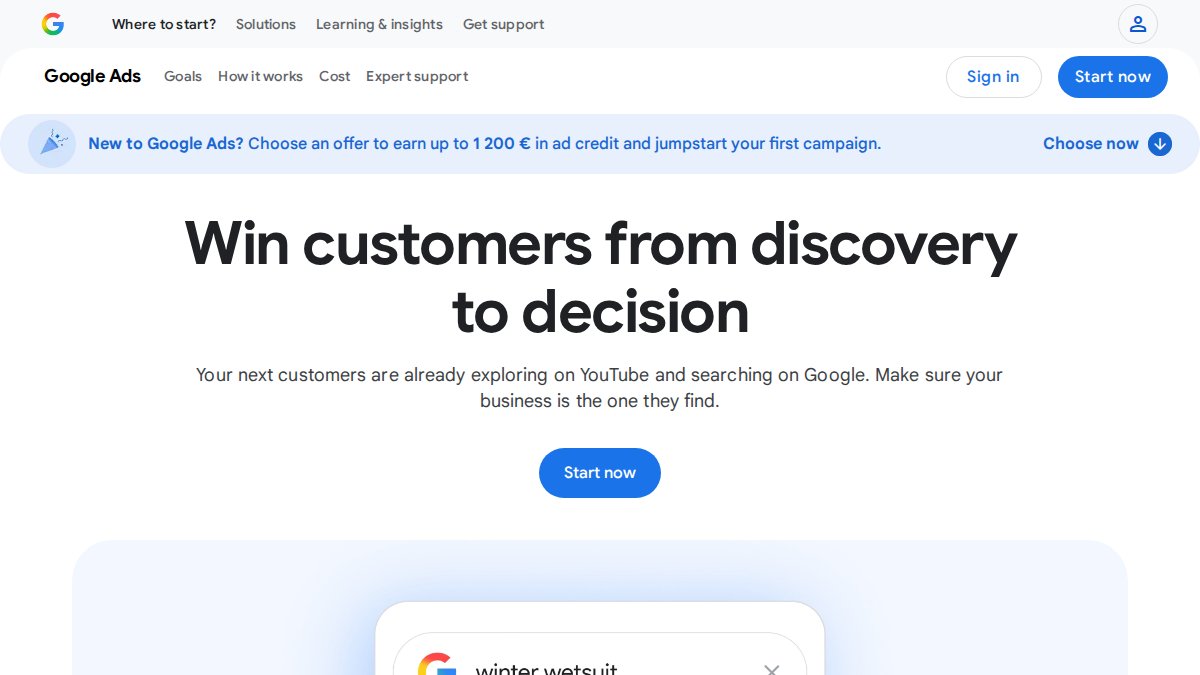
Google Ads remains the gold standard for capturing customers actively searching for products. When someone types "best running shoes under $100," Google Ads puts your product in front of them at that exact moment.
The platform offers multiple formats: Search Ads target keywords directly, Shopping Ads display product images and prices in search results, and Performance Max campaigns automate reach across Google's entire network. For ecommerce, Shopping Ads are often the highest-ROI channel because they reach customers with explicit purchase intent.
The barrier to entry is low, you set your budget, and Google handles the rest. But effective Google Ads requires ongoing optimization. Keyword selection, bid management, and landing page quality all impact performance. Small stores often underspend on Google because they lack in-house expertise to manage campaigns properly.
Mother-in-Law's Kimchi achieved 270% increase in online sales using Google Ads and Google Shopping since 2019, demonstrating that the platform works at scale. The store averaged 2 million digital impressions per year.
Meta Ads Manager: Visual Prospecting and Retargeting
Meta Ads Manager is where you go when you need to reach new customers at the awareness stage. Facebook and Instagram users aren't actively searching for products, they're scrolling feeds. Meta's targeting is granular: you can reach people by interests, behaviors, demographics, and lookalike audiences built from your existing customers.
Dynamic product ads automatically show different products to different people based on their browsing history. If someone viewed running shoes on your site, Meta will show them running shoes in their feed. This automation reduces the manual work of creating separate ads for each product.
The platform excels at visual prospecting. If your products photograph well and your store has a strong aesthetic, Meta drives consistent volume at lower costs than Google. The trade-off: conversion rates from Meta traffic are typically lower than Google because intent is lower. You're reaching people in discovery mode, not purchase mode.
High competition in your product category will drive up costs. Popular categories like beauty, fashion, and supplements see brutal CPM inflation on Meta. Niche categories perform better.

Amazon Ads: Direct Sales on the World's Largest Marketplace
Amazon Ads is the only platform on this list that sells directly on Amazon's marketplace rather than driving traffic to your own store. If you sell on Amazon, Sponsored Products, Sponsored Brands, and Sponsored Display are essential channels.
The advantage is obvious: you're reaching shoppers actively on Amazon, comparing products, ready to buy. Amazon shoppers have payment methods on file and trust Amazon's fulfillment. Friction is minimal.
The disadvantage: you're building someone else's business. Amazon controls pricing, takes a commission, and can change the rules anytime. You're also competing directly with other sellers in your category, which drives up costs.
Sponsored Products (ads for individual listings) are the highest-ROI format for most sellers. Sponsored Brands (ads showcasing your brand and multiple products) build awareness. Sponsored Display (ads across Amazon and third-party sites) retargets people who've visited your listings.
If you sell on Amazon, you should be running ads there. If you only sell on your own store, Amazon Ads isn't relevant.
How to Improve ROAS for Small Ecommerce Stores
ROAS, return on ad spend, is the metric that matters most for ecommerce profitability. A 4:1 ROAS ratio is often considered a good benchmark for many campaigns, though the average ROAS across most industries is approximately 2.87:1.
Improving ROAS starts with audience segmentation. Not all customers are equal. A customer who's purchased three times has a 10x higher lifetime value than a first-time buyer. Your ad spend should reflect this. Allocate more budget to retargeting existing customers and lookalike audiences built from your best customers. Spend less on broad prospecting until you've optimized your conversion funnel.
AI Performance Marketing Platform →
Creative testing is the second lever. The same product, shown in different ways, generates wildly different results. A lifestyle photo outperforms a product shot. A testimonial video outperforms a carousel ad. You won't know which creative works until you test. Most small stores test too conservatively, they run three variations and pick a winner. Run 8-10 variations simultaneously, let the algorithm identify the top two, and build on what works.
Conversion rate optimization on your store matters as much as ad optimization. If your ads drive traffic but your store converts at 1.5%, you're wasting money. Focus on: clear product descriptions, customer reviews, fast checkout, and mobile optimization. These fundamentals move the needle more than most ad platforms can.
Finally, track the right metrics. Many small stores optimize for clicks or impressions because those are easy to measure. Optimize instead for revenue and customer lifetime value. A campaign that costs more per click but generates higher-value customers is always the winner.
Best Practices for Ecommerce Customer Acquisition
Small businesses with revenues less than $5 million should allocate 7-8% of their revenues to marketing, according to the U.S. Small Business Administration (SBA). For a $500K revenue store, that's $35K-$40K annually. Most small stores underspend relative to this benchmark, which limits growth.
Budget allocation across channels matters. Don't put all your budget into one platform. Cross-channel marketing coordination shows a higher likelihood of year-over-year performance gains compared to siloed channels. This means a store running Google Ads and Meta simultaneously can outperform a store running only Google, assuming equal total spend.
Customer acquisition cost (CAC) is the metric that bridges advertising and profitability. Calculate it simply: total ad spend divided by new customers acquired. If you spend $1,000 on ads and acquire 20 new customers, your CAC is $50. Compare this to customer lifetime value (CLV). Average CLV for ecommerce brands ranges between $100 and $300. If your CLV is $150 and your CAC is $50, you're profitable on customer acquisition alone, and that's before counting repeat purchases.
Retention compounds profitability. A customer acquired for $50 who makes one purchase has a 2:1 ROI. That same customer who makes three purchases over two years has a 6:1 ROI. This is why email marketing and SMS automation matter so much for ecommerce. The cost to reach an existing customer is near-zero compared to acquiring new ones.
Segmentation by source reveals which channels actually drive value. A channel that looks expensive on CAC might drive high-CLV customers who repeat. Another channel might look cheap but drive one-time buyers. Track this. Allocate more budget to channels that drive high-CLV customers, even if the initial CAC is higher.
Choosing the Right Platform for Your Store
The decision framework is simpler than it appears. Start with your primary goal: are you retargeting existing visitors, prospecting for new customers, or doing both?
If retargeting is your priority, AdRoll or a unified platform like NeuroAds Inc. works well. Both handle audience segmentation and dynamic creative automatically. AdRoll offers various pricing plans; NeuroAds Inc. integrates directly with Shopify and includes chatbot automation for objection handling.
If prospecting dominates your strategy, Google Ads and Meta Ads Manager are your core channels. Google captures high-intent searchers. Meta reaches people in discovery mode. Run both. Allocate 60% of budget to Google if your products are frequently searched; allocate 60% to Meta if your brand is visual-first.
If you're selling on Amazon, Sponsored Products are non-negotiable. Treat Amazon as a separate channel with its own budget and optimization cycle.
Consider your team's capacity. Google Ads and Meta Ads Manager require ongoing optimization. If you have one person managing marketing, you'll struggle to run both effectively. A unified platform like NeuroAds Inc. reduces the operational burden by consolidating channels into a single interface.
Integration with your existing stack matters. If you use Shopify, prioritize platforms with native Shopify integration. If you use a custom ecommerce platform, you'll need an API connection or manual data sync. This overhead adds up.

| Platform | Best For | Starting Cost | Key Advantage |
|---|---|---|---|
| NeuroAds Inc. | Unified Shopify growth | Contact for pricing | AI optimization + chatbot automation |
| AdRoll | Multichannel retargeting | Varies by plan | Affordable, easy setup |
| Google Ads | High-intent prospecting | You set budget | Captures active searchers |
| Meta Ads Manager | Visual prospecting | You set budget | Broad reach, visual products |
| Amazon Ads | On-marketplace sales | You set budget | Direct sales, high intent |
Conclusion
Small ecommerce stores have more platform options than ever, but the abundance creates decision paralysis. The right choice depends on your business stage, product type, and team capacity.
If you're optimizing for profitability and want unified control over your customer journey, from ad click through purchase and recovery, the AI Advertising Platform from NeuroAds Inc. integrates ad optimization, predictive targeting, and Shopify chatbot automation into one system. This conversion-first approach fixes the targeting and conversion gaps that drain ROAS for most small stores.
Get started with the AI Advertising Platform from NeuroAds Inc. and improve your return on ad spend with AI-powered optimization and automated customer recovery.
=== FAQ ANSWERS (audit these too, same rules) ===
[1] Q: What are the best Criteo alternatives for small businesses? A: The best Criteo alternatives for small ecommerce stores include AdRoll for multichannel retargeting, Google Ads for high-intent search traffic, Meta Ads Manager for visual prospecting, and Amazon Ads for direct marketplace sales. Each platform offers different strengths: AdRoll excels at retargeting with various pricing options, Google Ads captures active searchers, and Meta provides broad audience reach. For small brands seeking AI-powered optimization specifically designed for ecommerce conversion, unified platforms that integrate advertising with customer journey automation offer superior ROAS improvement compared to traditional retargeting-only solutions.
[2] Q: Does Criteo work for small ecommerce stores? A: Criteo is primarily designed for larger ecommerce operations with substantial ad budgets and product catalogs. Small stores often find Criteo's pricing structure and minimum spend requirements prohibitive. Smaller brands typically benefit more from platforms offering lower entry costs and simpler setup, such as AdRoll or Google Ads with flexible daily budgets. For small ecommerce stores doing $2M or less in annual revenue, alternatives that combine AI-powered optimization with integrated conversion tools, rather than pure retargeting, deliver better ROI on limited marketing budgets.
[3] Q: How do I choose an ad platform for a growing Shopify store? A: Evaluate platforms based on three factors: your current ROAS benchmark, integration depth with Shopify, and automation capabilities. If your ROAS is stuck around 2.5:1 (the current industry average), prioritize platforms offering AI-driven optimization and predictive targeting rather than manual bid management. Check native Shopify integrations to avoid manual data syncing. For stores under $5M in revenue, platforms offering conversion-first strategies, combining ad optimization with customer objection handling and abandoned cart recovery, typically outperform traditional advertising-only tools. Test the platform's ease of setup; most small teams lack dedicated ad ops specialists.
[4] Q: What is the difference between retargeting and full-funnel AI advertising? A: Retargeting shows ads only to people who've already visited your store, aiming to bring them back. Full-funnel AI advertising reaches prospects across awareness, consideration, and conversion stages using predictive targeting and dynamic creative optimization. Retargeting works best for recovering abandoned carts and repeat purchases but misses new customer acquisition. Full-funnel platforms use machine learning to identify lookalike audiences, optimize bid amounts in real time, and test multiple creative variations automatically. For small ecommerce stores, full-funnel AI approaches can lead to improved conversion rates compared to retargeting alone.
Frequently Asked Questions
What are the best Criteo alternatives for small businesses?
The best Criteo alternatives for small ecommerce stores include AdRoll for multichannel retargeting, Google Ads for high-intent search traffic, Meta Ads Manager for visual prospecting, and Amazon Ads for direct marketplace sales. Each platform offers different strengths: AdRoll excels at retargeting with various pricing options, Google Ads captures active searchers, and Meta provides broad audience reach. For small brands seeking AI-powered optimization specifically designed for ecommerce conversion, unified platforms that integrate advertising with customer journey automation offer superior ROAS improvement compared to traditional retargeting-only solutions.
Does Criteo work for small ecommerce stores?
Criteo is primarily designed for larger ecommerce operations with substantial ad budgets and product catalogs. Small stores often find Criteo's pricing structure and minimum spend requirements prohibitive. Smaller brands typically benefit more from platforms offering lower entry costs and simpler setup, such as AdRoll or Google Ads with flexible daily budgets. For small ecommerce stores doing $2M or less in annual revenue, alternatives that combine AI-powered optimization with integrated conversion tools, rather than pure retargeting, deliver better ROI on limited marketing budgets.
How do I choose an ad platform for a growing Shopify store?
Evaluate platforms based on three factors: your current ROAS benchmark, integration depth with Shopify, and automation capabilities. If your ROAS is stuck around 2.5:1 (the current industry average), prioritize platforms offering AI-driven optimization and predictive targeting rather than manual bid management. Check native Shopify integrations to avoid manual data syncing. For stores under $5M in revenue, platforms offering conversion-first strategies, combining ad optimization with customer objection handling and abandoned cart recovery, typically outperform traditional advertising-only tools. Test the platform's ease of setup; most small teams lack dedicated ad ops specialists.
What is the difference between retargeting and full-funnel AI advertising?
Retargeting shows ads only to people who've already visited your store, aiming to bring them back. Full-funnel AI advertising reaches prospects across awareness, consideration, and conversion stages using predictive targeting and dynamic creative optimization. Retargeting works best for recovering abandoned carts and repeat purchases but misses new customer acquisition. Full-funnel platforms use machine learning to identify lookalike audiences, optimize bid amounts in real time, and test multiple creative variations automatically. For small ecommerce stores, full-funnel AI approaches can lead to improved conversion rates compared to retargeting alone.
This article was written using GrandRanker