 how-to
How an AI Campaign Optimization Platform Works in 2026
Last Updated: October 29, 2026
Quick Summary
An AI campaign optimization platform uses machine learning to automatically adjust live ad campaigns, changing bids, budgets, audiences, and creative based on performance signals instead of manual review cycles. It handles decisioning, diagnosis, and execution so your team no longer makes thousands of small adjustments by hand.
- Only 29.1% of agencies use AI for media planning and 22.1% for media-buying strategy.
- Score vendors 1-5 on data depth, override controls, audit trail, channel coverage, exports, and setup effort.
- Set a maximum daily spend change, a budget floor, and campaigns the model cannot touch before switching on automation.
- Dynamic creative optimization delivers a 32% higher click-through rate when fed genuinely different angles.
- Keep 10-15% of spend on your manual process for a full quarter as a holdout.
Table of Contents
- What an AI Campaign Optimization Platform Actually Does
- AI Ad Optimization Tools: What to Look For Before You Commit
- Step 1: Connect Your Ad Accounts and Shopify Data
- Step 2: Set Budget Guardrails and Human Oversight
- AI PPC Optimization in Practice: Bids, Budgets, and Creative Testing
- Cross-Platform Campaign Optimization Without the Siloed Reports
- Campaign Performance Analytics: Measuring What the Platform Changed
- Common Mistakes That Stall AI Optimization Results
- Frequently Asked Questions
What an AI Campaign Optimization Platform Actually Does
An AI campaign optimization platform is software that uses machine learning to adjust live ad campaigns automatically, changing bids, budgets, audiences, and creative based on performance signals rather than manual review cycles.
The distinction matters because most tools labeled "AI" in 2026 are dashboards with a recommendation panel bolted on. Real platforms act.
Three jobs define the category:
- Decisioning: bids, budgets, pacing, and frequency, the four levers StackAdapt's 2026 guide to AI in advertising identifies as the core of campaign optimization
- Diagnosis: spotting where performance broke and why, before spend compounds the error
- Execution: shipping creative variants and audience changes without waiting for a weekly meeting
Below, we walk through the setup sequence, the evaluation criteria that matter, and the mistakes that stall results.
AI Ad Optimization Tools: What to Look For Before You Commit
Most buyers evaluate AI ad optimization tools on feature counts. That is the wrong test. For a fuller breakdown of the evaluation criteria, see this buyer's guide to AI advertising platforms.
Ask three questions in every demo. Where does the model get its conversion data? Can a human override any automated decision, and how fast? What does the platform do when a signal contradicts itself, for example when platform-reported conversions and Shopify orders diverge?
That last question separates serious vendors from sales decks. Attribution disagreements are normal, and a platform that hides them is hiding its own error rate.
Score Every Vendor on the Same Six Criteria
A more useful approach is to score each vendor 1-5 on the criteria that actually predict whether automation produces lift, then weight the scores by what matters for your account size and channel mix.
| Criterion | What to verify in the demo | Why it predicts results |
|---|---|---|
| Data depth | Does it ingest post-click outcomes (orders, refunds, margin) or only platform-reported metrics? | Models trained only on platform-reported conversions optimize toward the platform's own attribution, not incremental revenue |
| Override controls | Can you cap, pause, lock, or schedule any automated action at campaign, ad set, and ad level? | Guardrails determine how much damage a bad model day can do |
| Audit trail | Is every change logged with timestamp, reason, and model version? | Without a log you cannot diagnose regressions or satisfy finance |
| Channel coverage | One budget view across search, social, and retail media, or separate tools per channel? | Cross-channel allocation is where most incremental gain sits |
| Reporting and exports | Can you pull change-level and outcome-level data into your own warehouse? | You need raw data to run holdout and incrementality tests |
| Setup effort | How many engineering hours before the first recommendation? | A platform that needs months of stitching before it acts is a 12-month liability |
Score each vendor before the demo ends, while the answers are fresh. Vendors that score well on data depth and override controls but poorly on setup effort are common; decide in advance which trade-off you will accept.
Match the Tool to Your Channel Mix and Volume
The right platform depends on where your spend sits. A brand weighted toward paid search needs strong bid and query-level automation; a social-heavy brand needs creative variant generation and audience expansion; a brand running retail media alongside both needs a single budget pool that can move spend across all three.
Volume matters too. Below a certain monthly ad spend, the learning signal is too thin for aggressive automation, and a platform that pushes full automation at low volume is optimizing on noise.
Total Cost of Ownership, Not Sticker Price
Fees are only one line of the cost. Add the engineering time to connect data sources, the analyst hours to review the change log, the ad spend the model will test with, and the switching cost if you leave.
Ask vendors how fees scale with spend, what happens to your data if you cancel, and whether historical change logs are exportable. Those three answers tell you more than the pricing page does.
Step 1: Connect Your Ad Accounts and Shopify Data
Start with the data layer, because every downstream decision inherits its flaws. Connect your ad accounts first, then your e-commerce platform, then your analytics.
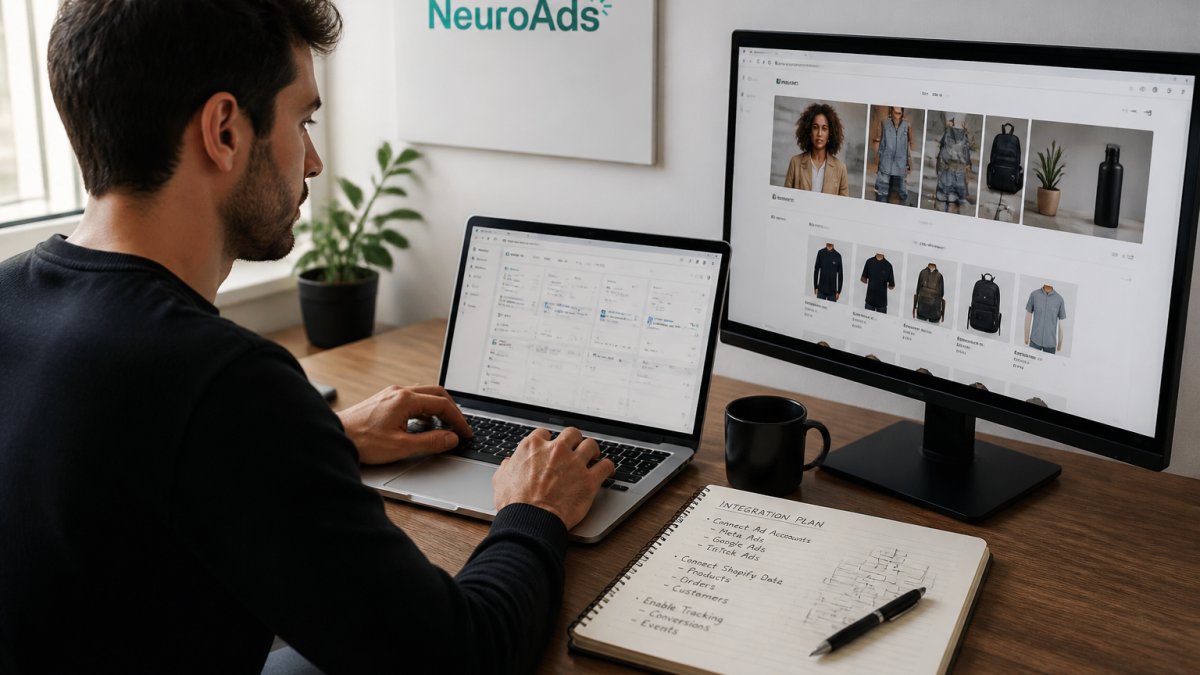
Expect the first reconciliation to fail.
Practical sequence:
- Link ad accounts with the same currency and time zone settings across all channels
- Connect your store so post-click conversion data flows back to the platform
- Pull in analytics for session-level behavior, not just last-click totals
Fragmented data is the norm, not the exception. A platform that requires heavy manual stitching before it produces a single recommendation is telling you something about the next twelve months.
Step 2: Set Budget Guardrails and Human Oversight
Automation without limits is how brands lose money fast. Set guardrails before you switch anything on.
Define a maximum daily spend change per campaign, a floor below which the platform cannot cut budget, and a list of campaigns the model cannot touch at all.
Then assign a human owner. Not a committee, one person who reviews the change log daily for the first two weeks and weekly after that.
AI Performance Marketing Platform →
AI PPC Optimization in Practice: Bids, Budgets, and Creative Testing
AI PPC optimization works best when you separate the decisions that are safe to automate from the ones that need judgment. Bids and budget pacing are safe. Creative strategy is not.
Here is how we would split it:
| Decision | Automate? | Why |
|---|---|---|
| Bid adjustments | Yes, fully | Fast-moving, reversible, data-rich |
| Daily budget pacing | Yes, with caps | Prevents overspend, improves distribution |
| Audience expansion | Yes, with review | Model finds pockets humans miss |
| Ad copy direction | Partially | Generate variants, human picks the angle |
| Offer and pricing | No | Brand and margin decisions |
Creative testing is where the use sits. Dynamic creative optimization, which swaps ad elements in real time based on audience data, delivers a 32% higher click-through rate according to Luma Labs' 2026 advertising statistics. This how-to guide to creative testing covers the testing tactics in detail.
Cross-Platform Campaign Optimization Without the Siloed Reports
Siloed reporting is the most common reason cross-platform campaign optimization stalls. Each channel optimizes for its own attributed conversions, so budgets flow toward whichever platform claims the most credit, not the one creating the most incremental revenue. The fix is a repeatable reallocation process that treats channels as one portfolio. This guide to cross-channel ad optimization strategies walks through the process in more depth.
Why Platform-Reported ROAS Misallocates Budget
Every major ad platform counts a conversion it touched, and the same order can be claimed by search, social, and email at once. When you sum platform-reported revenue, the total routinely exceeds actual store revenue.
A common pattern: a brand sees social reporting a 4.0 ROAS and search reporting a 2.5 ROAS, cuts search, and watches total revenue fall. Search was closing demand social created. The platform-level numbers were both "right" and both misleading.
A Channel-Agnostic Reallocation Playbook
Use the same loop across search, social, and retail media so results are comparable:
- Set one objective and one attribution window. Pick a single conversion definition (for example, new-customer orders within a 7-day click window) and apply it to every channel. Mixed windows make cross-channel comparison meaningless.
- Establish a baseline period. Run two to four weeks with current budgets and no structural changes so the model and your team have a stable reference.
- Define the reallocation unit. Decide the smallest budget move you will make (for example, 10% of a channel's weekly spend) and the cadence (weekly, not daily). Small daily moves reset learning and produce noise.
- Rank channels by marginal return, not average return. Average ROAS tells you what a channel did; marginal return tells you what the next dollar will do. Ask the platform for spend-response or marginal ROAS reporting, and if it cannot produce it, approximate with stepped budget tests.
- Move budget in one direction per cycle. Shift from the lowest marginal channel to the highest, then hold for a full learning window before the next move.
- Log every move with its rationale. The change log becomes your reallocation history and the input to the next cycle.
Set Reallocation Guardrails
Unlimited reallocation is how a model starves a channel that needs sustained spend to perform. Set a maximum share any single channel can receive, a floor below which a proven channel cannot be cut, and a list of campaigns excluded from reallocation entirely (brand terms, legal-review campaigns, always-on prospecting). Review channel-level spend weekly but resist overriding allocation daily; the model needs time to learn.
Worked Example: Three Channels, One Budget Pool
A brand runs search, social, and retail media with a combined weekly budget. In the baseline period, search shows the highest average ROAS but flat marginal return as spend rises, social shows lower average ROAS but rising marginal return, and retail media is stable. The playbook moves a 10% slice from search to social, holds for two weeks, and re-measures marginal return.
Keep the Data Layer Consistent
Two rules make the playbook work. First, keep one currency and one attribution window across all channels. Second, export change-level and outcome-level data to your own warehouse so you can run holdout tests independent of any platform's reporting. Platform dashboards are for monitoring; your warehouse is for deciding.
Campaign Performance Analytics: Measuring What the Platform Changed
The only measurement that matters is the counterfactual: what would have happened without the platform? Standard reporting cannot answer that, which is why so many teams cannot prove their automation works.
Build a holdout. For more on unified performance signals versus ROAS, see this article.
According to Omneky's 2026 AI advertising statistics, brands using AI creative optimization report an average ROAS improvement of 32% within 90 days.
Common Mistakes That Stall AI Optimization Results
The pattern we see most often: brands buy a platform, connect accounts, and then keep making the same manual changes they made before. If you are still deciding between adopting a platform and hiring help, this comparison of AI advertising platforms and traditional agencies lays out the trade-offs.
Four mistakes account for most stalled results:
- Overriding daily. Every manual change resets the learning window. Give the model two weeks before judging it.
- Feeding it bad data. Duplicate conversion events inflate results and skew budget allocation toward the wrong channel.
- No holdout group. Without a control, you cannot separate platform impact from seasonality.
That last one is where most ROAS problems actually live. NeuroAds Inc. pairs ad optimization with a Shopify chatbot that handles objections and recovers abandoning shoppers.
Frequently Asked Questions
What is an AI campaign optimization platform?
It is software that watches your paid advertising campaigns and adjusts bids, budgets, audiences, and creative based on performance signals rather than a fixed schedule. Most platforms pull data from Google, Meta, TikTok, and other channels, then recommend or apply changes automatically. The useful ones go further than reporting: they decide where the next dollar should go and flag when a campaign is drifting. NeuroAds Inc. adds a conversion-first layer, pairing ad optimization with a Shopify chatbot that recovers shoppers before they leave.
How do you measure the performance of AI-optimized campaigns?
Start with return on ad spend and cost per acquisition, then add incrementality checks so you know the lift came from the platform and not from seasonality. Track conversion rate by channel, click-through rate on creative variants, and budget pacing against plan. Run a holdout or geo test for at least four weeks before crediting the platform with a gain. Campaign performance analytics should show what changed, when, and which decision drove it, not just a dashboard of totals.
Can AI optimize campaigns across multiple advertising platforms?
Yes, and that is where cross-platform campaign optimization earns its keep. A platform that sees Google, Meta, TikTok, and Pinterest in one view can move budget toward the channel producing the lowest cost per acquisition instead of letting each channel's algorithm compete for the same dollar. The catch is data quality: if conversion tracking differs between channels, the platform will optimize toward bad numbers. Confirm your tracking is consistent before you trust automated budget allocation.
What are the limitations of AI campaign optimization?
AI cannot fix a weak offer, a broken checkout, or creative that never tested well with real buyers. It also needs enough conversion volume to learn; small accounts often get noisy recommendations. Human oversight still matters for brand safety, margin targets, and promotions the model cannot see. The 2026 Advertising Agency Report found only 29.1% of agencies use AI for media planning, which suggests many teams still prefer manual control. Treat the platform as a fast analyst, not a replacement for judgment.
The challenge is not finding automation; it is building a system where automation, guardrails, and measurement reinforce each other. NeuroAds Inc. was built for that: AI-powered ad optimization and predictive targeting, cross-channel campaign management in one view, and an integrated Shopify chatbot that closes the gap between click and purchase. Start with the AI Advertising Platform and give your paid traffic a conversion-first structure.